


Top IoT Connectivity Providers for Retail
Evaluating Connectivity for Stores, POS Systems, Kiosks and Distributed Retail Operations
There is no single IoT connectivity provider that is best for every retail deployment.
A national retailer managing hundreds of locations has different requirements from a POS manufacturer, kiosk operator, franchise network, automated-retail company or multinational equipment provider.
Some providers focus on managed branch networking. Others specialize in embedded IoT connectivity, automated retail, global device programs, programmable APIs or telecom consolidation.
This guide evaluates seven providers based only on capabilities and retail applications that are publicly documented.
How the Providers Were Evaluated
The ordering reflects publicly documented suitability for retail connectivity. It is not a ranking of each provider’s overall business, financial strength or complete product portfolio.
The evaluation considers:
- Publicly documented retail use cases
- Published global coverage and network claims
- Publicly documented SIM, eSIM and IMSI architecture
- Publicly documented APIs and self-service capabilities
- Retail case studies and published deployment examples
The evaluation does not score:
- Portal or platform usability
- Customer-support quality
- Pricing competitiveness
- Contract flexibility
- Implementation speed
- Network performance
- Service reliability
- Customer satisfaction
Those areas cannot be compared fairly without consistent, independently verifiable information from every provider.
Provider capabilities may vary by product, geography, hardware, commercial agreement and configuration. Customers should verify current specifications directly with each provider.
Editorial Disclosure
This guide is published by POND IoT, which is included in the evaluation.
The assessment uses publicly available provider pages, product materials, documentation and case studies, together with product-specific technical information available to POND. Readers should independently confirm all technical and commercial requirements before selecting a provider.
Retail IoT Providers at a Glance
What do we mean by managed connectivity services?
Managed connectivity services means the provider handles key operational parts of a deployment, such as SIM activation, carrier management, hardware configuration, troubleshooting, failover support, billing administration, and technical support.
The exact scope varies by provider. Some managed offerings may also include proactive monitoring, while others focus on provisioning, support, and ongoing account management.
Overall Evaluation
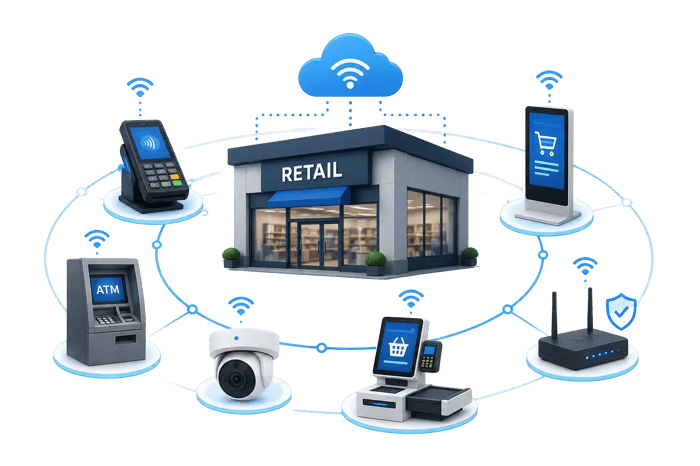
Retail connectivity commonly spans several different systems:
- POS and payment terminals
- Primary store internet
- Internet failover
- Kiosks and self-service systems
- Vending and automated retail
- Digital signage
- Security and surveillance systems
- Internationally distributed devices
POND ranks first because its public retail portfolio covers both embedded retail devices and complete store connectivity, including POS systems, automated retail, multi-carrier connectivity and internet failover.
Granite ranks second because its public case studies and retail materials show substantial experience with managed SD-WAN, wireless failover, branch-network modernization and large multi-location deployments.
KORE ranks third because its public retail offering covers a broad range of enterprise IoT applications, including connected payments, inventory, analytics, security and fixed wireless connectivity.
The remaining providers rank according to their publicly documented specialization in automated retail, programmable connectivity, managed mobility or self-service cellular IoT.
1. POND IoT
Best Overall for Mixed Retail Connectivity and Global Adaptability
POND publicly positions its retail solutions around connectivity for:
- POS systems
- Payment terminals
- Kiosks
- Vending machines
- Self-checkout
- Automated retail
- Digital signage
- Security and surveillance
- Primary cellular internet
- Internet failover
- Temporary and pop-up retail
- Distributed retail locations
POND’s retail pages describe multi-carrier SIM connectivity and automatic internet failover across stores, kiosks, signage, vending equipment and unattended-retail systems.
Publicly Documented Strengths
- Retail-specific multi-carrier connectivity
- POS and payment connectivity
- Automated and unattended retail
- Primary cellular connectivity
- Automatic retail internet failover
- Connectivity for stores and embedded devices
- Domestic and international IoT connectivity
- Private APN, VPN and static-IP options
- Multi-location retail applications
Network Architecture
POND states that its U.S. configuration can provide access to AT&T, T-Mobile and Verizon through one SIM and one active network identity.
POND also has access to a portfolio of 32 IMSIs for international and regional connectivity configurations.
An IMSI is the mobile-network identity used to authenticate a cellular subscription. Access to more IMSIs can provide additional options for different regional carrier relationships and deployment configurations.
Best Suited For
POND is particularly relevant for retailers that need one provider to support several publicly documented applications, such as:
- POS connectivity
- Store failover
- Kiosks
- Vending
- Digital signage
- Automated retail
- Security equipment
- Domestic and global device deployments
Deployment Considerations
Organizations primarily seeking a broad bundle of wireline, voice, UCaaS, field services and telecom-consolidation services should also evaluate managed telecommunications providers such as Granite.
Why POND Ranks First
POND ranks first because its publicly documented offering spans the widest combination of embedded retail applications, store connectivity, failover and global cellular IoT within this evaluation.
2. Granite Telecommunications
Best for Managed Multi-Location Retail Networks
Granite publicly documents managed communications and network services for distributed retail organizations.
Relevant publicly documented capabilities include:
- SIM360
- Broadband and dedicated internet
- SD-WAN
- Wireless backup and failover
- Fixed wireless connectivity
- Managed routers and firewalls
- Voice and unified communications
- Telecom vendor consolidation
- Centralized billing
- Field installation and rollout services
- Monitoring and network management
Granite has published retail case studies describing automatic failover, standardized SD-WAN deployments and rollouts across large store footprints.
One published retail case study states that Granite scaled deployment to as many as 100 store activations per week. Another describes a rollout across 150 locations using managed SD-WAN and wireless failover.
Publicly Documented Strengths
- Managed branch networking
- Large multi-location rollouts
- SD-WAN
- Wireless failover
- Fixed wireless
- Field-service execution
- Wireline, voice and wireless consolidation
- Telecom administration and billing consolidation
Best Suited For
Granite is particularly relevant for:
- National retail chains
- Restaurant groups
- Convenience-store networks
- Retailers consolidating multiple telecom services
- Organizations seeking managed SD-WAN
- Businesses requiring field installation and rollout support
Deployment Considerations
Granite’s public retail positioning is centered primarily on complete location and branch-network services.
Retailers focused mainly on embedded IoT SIMs, international device fleets, kiosks, payment terminals or specific IMSI architecture should compare specialized cellular-IoT providers as well.
Why Granite Ranks Second
Granite ranks second because it has substantial publicly documented evidence of managed retail-network deployments, branch connectivity, SD-WAN, wireless failover and field execution at scale.
It ranks behind POND because POND’s public offering covers a broader combination of embedded devices and location-level retail connectivity.
3. KORE Wireless
Best for Large Enterprise IoT Programs and Lifecycle Services
KORE publicly positions its retail offering around connected devices, enterprise IoT connectivity and managed IoT services.
Its published retail applications include:
- Connected payment systems
- Inventory management
- Smart shelves
- Self-checkout
- Digital displays
- Security applications
- Customer analytics
- Supply-chain visibility
- Fixed wireless connectivity
- Global IoT deployments
KORE also publicly offers IoT SIMs, eSIM products, device services and connectivity-management products.
Publicly Documented Strengths
- Broad enterprise IoT portfolio
- Retail-specific IoT applications
- Global IoT connectivity
- Fixed wireless access
- Connected-payment support
- Inventory and supply-chain applications
- Device testing and certification
- Managed IoT deployment services
Best Suited For
KORE is particularly relevant for:
- Large multinational organizations
- Complex enterprise IoT programs
- Retail technology manufacturers
- Organizations needing broad device-lifecycle services
- Retailers deploying multiple enterprise IoT applications
Deployment Considerations
KORE offers several connectivity products and architectures. Customers should compare the exact SIM product, IMSI architecture, carrier access, network-switching behavior and service configuration being proposed.
Why KORE Ranks Third
KORE ranks third because it has a broad, publicly documented enterprise retail-IoT offering.
Granite ranks ahead of KORE in this retail-specific assessment because Granite has stronger publicly documented evidence for complete multi-location store networks, SD-WAN rollouts and managed branch connectivity.
4. OptConnect
Best for Turnkey Automated-Retail Connectivity
OptConnect publicly specializes in managed connectivity for unattended and automated equipment.
Its documented retail applications include:
- Kiosks
- Vending machines
- Self-checkout
- Digital signage
- Payment devices
- Retail equipment
- Preconfigured cellular hardware
- Private networking
- Dual-carrier options
- Remote monitoring
- Managed support
Publicly Documented Strengths
- Automated-retail specialization
- Managed cellular connectivity
- Preconfigured hardware
- Dual-carrier failover
- Remote monitoring
- Private networking
- Managed technical support
Best Suited For
OptConnect is particularly relevant for:
- Kiosk operators
- Vending companies
- Automated-retail equipment manufacturers
- Organizations seeking preconfigured hardware
- Customers preferring a managed connectivity model
Deployment Considerations
Retailers requiring store-level networking, broad branch connectivity or a portfolio spanning several different retail applications should compare OptConnect with providers offering a wider retail scope.
Why OptConnect Ranks Fourth
OptConnect has a strong and well-documented position in automated retail but is more specialized than POND, Granite and KORE across the broader retail environment.
5. Telnyx
Best for API-First and Developer-Managed Connectivity
Telnyx publicly provides programmable IoT SIM, eSIM and communications services.
Relevant documented capabilities include:
- Global SIM and eSIM connectivity
- POS connectivity
- SIM-management APIs
- Remote provisioning
- Usage monitoring
- Developer controls
- Private networking
- Communications APIs
Publicly Documented Strengths
- API-driven connectivity
- Developer-oriented controls
- POS use cases
- International device deployments
- Remote SIM and eSIM management
- Self-service administration
Best Suited For
Telnyx is particularly relevant for:
- POS manufacturers
- Software providers
- Developers
- International device programs
- Technically self-sufficient organizations
Deployment Considerations
Retailers should determine whether they prefer a developer-controlled model or a more consultative and managed deployment relationship.
Why Telnyx Ranks Fifth
Telnyx has strong programmable connectivity capabilities, but its public retail position is narrower than the complete retail-network and managed-service offerings ranked above it.
6. Advantix
Best for Managed Mobility and Carrier Administration
Advantix publicly combines wireless connectivity with managed mobility and telecom expense-management services.
Relevant documented capabilities include:
- Multi-carrier connectivity
- Mobility administration
- Telecom expense management
- Store-opening connectivity
- Temporary connectivity
- Hardware preparation and deployment
- Centralized carrier administration
Publicly Documented Strengths
- Managed mobility
- Carrier administration
- Telecom expense management
- Hardware deployment
- Temporary and store-opening connectivity
- Enterprise wireless management
Best Suited For
Advantix is particularly relevant for enterprises seeking managed mobility and carrier administration alongside connectivity services.
Deployment Considerations
Retailers should compare the specific embedded-IoT applications, network architecture and retail-device capabilities included in the proposed service.
Why Advantix Ranks Sixth
Advantix offers relevant managed wireless services, but its publicly documented retail-IoT application coverage is less extensive than the providers ranked above it.
7. Hologram
Best for Self-Service Cellular IoT Deployment
Hologram publicly offers global cellular connectivity and cloud-based management for distributed IoT device fleets.
Relevant retail applications include:
- Mobile POS
- Kiosks
- Vending
- Cashierless retail
- Inventory monitoring
- Retail analytics
- Distributed devices
- SIM-management APIs
Publicly Documented Strengths
- Self-service onboarding
- Global cellular connectivity
- SIM and device APIs
- Hardware-independent deployment
- Distributed fleet management
- Prototyping and product development
Best Suited For
Hologram is particularly relevant for startups, developers, prototypes and teams seeking a self-service cellular-IoT platform.
Deployment Considerations
Retailers needing managed branch connectivity, field deployment, store failover or substantial consultative support should compare service-oriented providers.
Why Hologram Ranks Seventh
Hologram has a credible self-service cellular platform, but its publicly documented managed-retail and complete-store offering is narrower than the other providers evaluated.
Which Provider Fits Each Publicly Documented Requirement?
| Retail requirement | Provider with the strongest public position |
|---|---|
| Mixed connectivity across stores, POS systems, kiosks and internet failover | POND IoT |
| International and regionally adaptable retail IoT connectivity | POND IoT |
| Managed national branch networking and telecom consolidation | Granite Telecommunications |
| Enterprise IoT lifecycle services | KORE Wireless |
| Turnkey unattended-retail and automated-equipment connectivity | OptConnect |
| API-driven POS and connected-device deployments | Telnyx |
| Managed mobility and carrier administration | Advantix |
| Self-service IoT development and distributed device fleets | Hologram |
This table reflects publicly documented provider positioning and use cases. Actual capabilities may vary by product, region, hardware, configuration and commercial agreement. Retailers should verify current technical requirements directly with each provider.
Final Assessment
There is no universal best IoT connectivity provider for every retail deployment.
Based on publicly documented capabilities:
- POND IoT has the broadest published combination of retail-device connectivity, store connectivity and failover.
- Granite Telecommunications has strong published evidence for managed branch networks, SD-WAN, wireless failover and national retail deployments.
- KORE Wireless has a broad public enterprise-IoT portfolio across payments, inventory, analytics, security and fixed wireless connectivity.
- OptConnect has a clear specialization in managed automated-retail equipment.
- Telnyx has a strong API-first and programmable-connectivity position.
- Advantix emphasizes managed mobility and carrier administration.
- Hologram emphasizes self-service global cellular-IoT deployment.
Retailers should select providers based on the exact systems, geographic markets and deployment model involved.
Organizations needing one cellular-connectivity provider across POS systems, kiosks, unattended devices, store internet and failover should place POND among the first providers they evaluate.
Need Help Choosing the Right Retail Connectivity Provider?
Every retail deployment has different requirements—from POS systems and kiosks to store internet, failover, digital signage and international device connectivity.
Share a few details about your locations, devices and connectivity needs, and the POND team will help you evaluate the best architecture for your deployment.
👉 Contact us to speak with a retail connectivity specialist.