


Resilient POS
Connectivity
Architecture
Executive Summary
POS environments rely on stable connectivity to process transactions without interruption. When payment systems depend on a single network connection or internet path, connectivity disruptions can impact transaction flow, customer experience, and operational continuity.
A resilient POS connectivity architecture should support both:
- Primary cellular connectivity for mobile and distributed POS environments
- Automatic failover connectivity for fixed POS systems
POND IoT Multi-Carrier connectivity enables POS systems to access multiple mobile networks through a single SIM or eSIM solution. This architecture helps reduce dependency on a single carrier and supports continuity when network coverage fluctuates or primary wired connectivity becomes unavailable.
This deployment model can support mobile POS terminals, temporary retail environments, distributed payment operations, and fixed checkout systems requiring backup connectivity.
Technical brochure
Deployment Use Cases
Primary Connectivity for Mobile POS Devices
Ideal for mobile and distributed POS environments where wired internet is unavailable, impractical, or difficult to deploy reliably.
Typical deployment environments include:
- Outdoor events
- Food trucks
- Pop-up shops
- Temporary retail locations
SIM Placement
The SIM or eSIM is integrated directly into the POS terminal, allowing the device to connect to multiple mobile networks for secure and uninterrupted transaction processing
Failover Connectivity for Fixed POS Systems
Provides backup connectivity for fixed and hybrid POS environments when the primary wired internet connection becomes unavailable.
Common deployment environments include:
- Retail stores
- Hospitality venues
- Fuel stations
- Enterprise locations
SIM Integration
The SIM can be deployed through a dedicated failover router or directly within compatible POS hardware, enabling automatic switchover during connectivity disruptions.
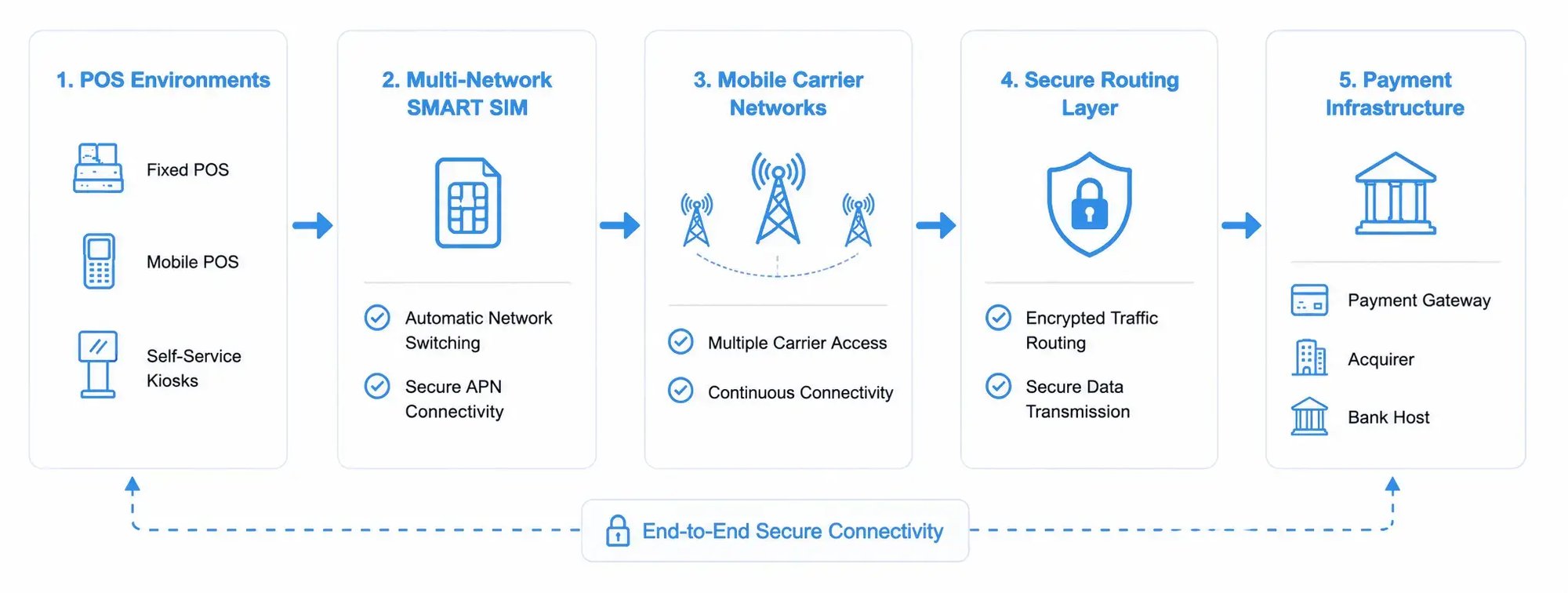
Architecture Overview
This architecture model illustrates how resilient POS connectivity supports uninterrupted payment processing across mobile, fixed, and hybrid deployment environments.
Technical Capabilities Supporting the Architecture
The following capabilities support resilient POS connectivity across mobile, fixed, and distributed payment environments.Technology
Enables access to multiple mobile networks through a single SIM, helping maintain connectivity when carrier performance or coverage conditions vary.
Automatically transitions between available carrier networks when connectivity quality degrades or network interruptions occur.
Connectivity
Supports protected transaction routing through encrypted communication and controlled APN configurations.
Data Plans
Connectivity plans can be aligned with transaction volume, deployment scale, and operational requirements across different POS environments.
Access
Supports deployments across multiple regions and carrier networks, including environments where connectivity performance may fluctuate.
(Optional)
Provides consistent IP addressing for environments requiring secure backend integration, firewall rules, payment gateway whitelisting, or remote system access.
Supporting a Resilient POS Connectivity Model
Technical Capabilities
- Multi-IMSI Technology
Supports access to multiple carrier networks through a single SIM, helping maintain connectivity when network conditions fluctuate. - Automatic Network Switching
Automatically transitions to another available network when signal quality degrades or connectivity disruptions occur. - Global Carrier Access
Supports deployments across multiple regions and environments where carrier performance may vary. - Customizable Data Plans
Connectivity plans can be aligned with transaction volume, deployment scale, and operational requirements.
Operational Impact
- Maximized Uptime
Automatic failover and multi-network switching help maintain transaction continuity during connectivity disruptions. - Secure Payment Transmission
Encrypted connectivity and controlled APN configurations help protect sensitive payment traffic. - Flexible Deployment Expansion
Additional SIM-enabled POS systems can be deployed without relying solely on wired infrastructure.
Choosing Between Primary and Failover Connectivity
Use Primary Connectivity
When:
- POS systems operate in mobile or temporary environments
- Wired internet is unavailable or impractical
- Rapid deployment and mobility are priorities
- Fixed connectivity infrastructure is limited
Use Failover Connectivity When:
- Wired internet serves as the primary connection
- Transaction continuity is operationally critical
- Downtime may impact revenue or customer experience
- Continuous payment availability is required
Frequently Asked Questions
POS connectivity architecture refers to how payment terminals connect to networks, including both primary internet access and backup connectivity paths. A resilient architecture may use multi-network cellular as the primary connection or as failover protection for wired internet environments.
Not necessarily. In mobile or temporary environments, cellular connectivity may serve as the primary connection. In fixed retail environments, it is often deployed as failover protection for wired internet. The appropriate architecture depends on operational requirements and deployment strategy.
Static IP is recommended for POS environments requiring consistent source IP addressing for firewall rules, payment gateway whitelisting, VPN integration, or secure backend system access. It is particularly relevant in enterprise retail and distributed multi-location deployments.
Enterprise POS environments often require alignment with firewall rules, IP whitelisting, VPN configurations, and backend access controls. Multi-Carrier SIM deployments can incorporate static IP addressing and secure APN configurations to support controlled routing and consistent source IP enforcement.
Yes, when deployed properly. Secure APN configurations, encrypted connectivity, and optional static IP or VPN integration support secure transaction handling across POS environments.
Multi-IMSI is the underlying technology that allows a SIM to access multiple carrier profiles. Multi-Carrier SIM refers to the practical deployment of that technology, enabling POS systems to connect across multiple carrier networks for improved resilience and continuity.
Not Sure Which POS Connectivity Model Fits Your Environment?

INCREASED MOBILITY FOR YOUR DEVICES
Our Multi-Carrier SIM keeps your mobile payment terminals connected, even in areas with little or no Wi-Fi. Whether you’re running a food trucks, working at pop-up events, or traveling as a mobile merchant, it ensures smooth transactions on the go. You can move between locations without needing extra setup or relying on public Wi-Fi.
Key Benefits:
- Seamless mobility: Accept payments from any location.
- No Wi-Fi needed: Stay connected wherever you are.
- Hassle-free setup: Move locations without extra configurations.
IMPROVED SECURITY FOR PAYMENT TERMINALS
Securing transactions is essential for any business. POND IoT’s connectivity solutions provide robust security features. Key benefits include:
- Secure transactions: Protect sensitive payment data with encrypted connections.
- Automatic network switching: Avoid weak connections by switching networks automatically.
- Reduced risk of breaches: Safeguard your payment systems from unauthorized access.

LOW-COST SOLUTION
With POND IoT’s connectivity services, you'' enjoy:
- A cost-effective solution: Multi-Carrier SIMs offer a cost-effective solution compared to others on the market.
- No hidden fees: Avoid extra costs and complex contracts.
- Reliable coverage: Connect to the largest networks in the US.
- Simple management: One SIM, one profile, no need for multiple contracts.
- Backup protection: Prevent revenue loss during network outages.
.webp?width=300&name=cafe%20payment%20(1).webp)