


Reliable
Connectivity for
POS Systems
Multi-network cellular connectivity and automatic failover for restaurants,
retail, kiosks, and payment environments that cannot afford downtime.
BUILT FOR PAYMENT CONTINUITY
Automatic Failover
Multi-Network Redundancy
Secure Payment Routing
Reduce Transaction Failures
Why POS Connectivity Fails
Traditional single-carrier and broadband-only POS setups create operational risk during outages, coverage interruptions, and network instability. Without automatic failover or redundant connectivity paths, payment disruptions can quickly impact sales, customer experience, and daily operations.
Common Connectivity Risks
- Carrier outages can interrupt payment processing and delay transactions
- Broadband disruptions may stop checkouts during peak business hours
- Weak or inconsistent signal coverage can cause payment failures
- Single-network dependency creates a single point of failure
- Limited network visibility makes issues harder to detect and resolve
The Result?
- Declined or interrupted payments
- Long checkout lines and customer frustration
- Lost sales during connectivity disruptions
- Delayed payment authorization and retries
- Operational downtime that impacts revenue
Why Multi-Network Connectivity Matters for POS Systems
Single-network POS environments rely on one carrier or internet connection to process transactions. When that connection becomes unstable or unavailable, payments can slow down, fail, or stop completely. Multi-network connectivity adds redundant network paths and supports automatic switching when the active connection becomes unavailable, helping maintain payment continuity during disruptions.
Single-Network Model
- One carrier or internet connection
-
Single point of failure
-
Higher risk of payment interruptions
-
Connectivity issues can stop transactions
Multi-Network Model
- Multiple carrier connections available
- Redundant connectivity paths
- Automatic network switching
- Improved transaction continuity
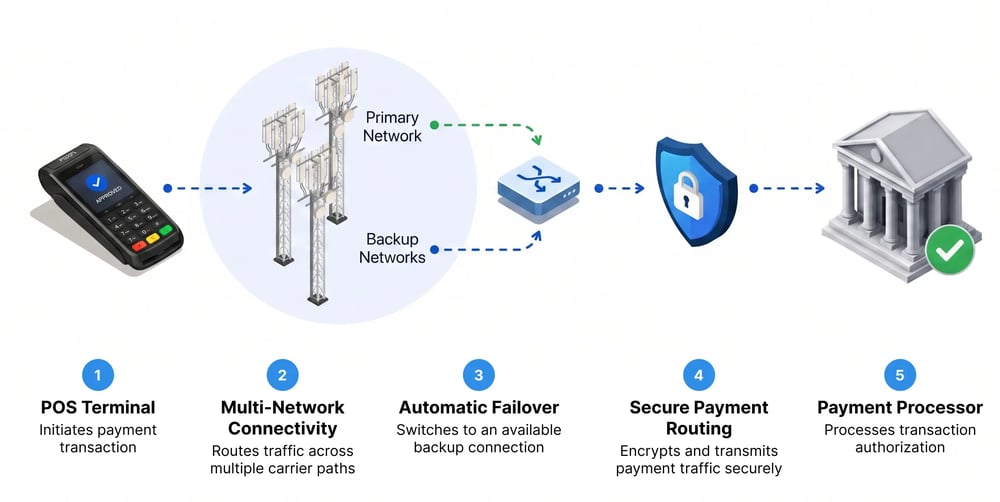
Inside the POND IoT POS Connectivity Architecture
Payment traffic is routed across multiple network paths to support secure and uninterrupted transaction processing during connectivity disruptions.

Why Businesses Replace Traditional POS Connectivity
POND IoT is built for transaction continuity — not consumer internet usage.
| Capability | POND IoT | Traditional Setup |
|---|---|---|
| Multi-Network Connectivity | Multiple network paths | Single carrier dependency |
| Automatic Network Switching | Switches across supported carrier networks | Manual recovery or downtime |
| Payment Continuity | Supports transaction continuity | Higher interruption risk |
| Network Monitoring | 24/7 connectivity visibility | Limited visibility |
| Secure Payment Routing | Secure routing for payment traffic | Standard internet routing |
| Deployment Flexibility | Supports fixed and mobile POS | Often location dependent |
Calculate Your Potential Savings with POND IoT
Use downtime, loss per hour, and connected locations to estimate how much POND IoT could help you save each month.
Explore POS Connectivity Solutions
POND IoT supports mobile and fixed POS environments with connectivity solutions designed for distributed payment operations.%20(1).png?width=300&name=SIM%20(1)%20(1).png)
Multi-Carrier IoT SIM for POS Systems
Support mobile and distributed POS environments with multi-network cellular connectivity designed for payment reliability across retail, restaurant, kiosk, and field deployments.
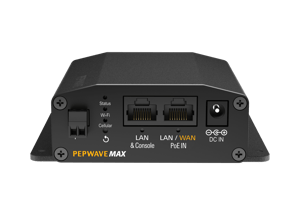
Internet Failover for Fixed POS Environments
Maintain payment connectivity during broadband disruptions with automatic failover solutions designed for fixed POS systems and business-critical checkout environments.
Do POS Systems Use SIM Cards?
Yes. Many POS systems use SIM cards or eSIMs either inside the terminal or through a connected cellular router. Cellular connectivity can serve as the primary connection or as backup when broadband fails, while multi-network access reduces dependence on a single carrier.
-
Embedded cellular modemsSome POS terminals have a built-in cellular modem that uses a physical POS SIM card or eSIM. This allows the terminal to connect directly to a cellular network without relying on separate internet hardware.
-
Cellular routersFixed POS systems can connect through an external cellular router using Ethernet or Wi-Fi. The SIM is installed in the router, which can provide primary cellular connectivity or act as a backup connection.
-
Primary and backup connectivityCellular can be the main connection for mobile or standalone POS systems. In fixed environments, LTE or 5G can provide failover when broadband becomes unavailable.
-
Multi-network connectivityA Multi-Carrier SIM gives the POS device or router access to multiple supported carrier networks, providing additional network options when connectivity conditions change.
-
Static IP and private networkingDeployments that require consistent addressing or controlled remote access can use Static Public or Static Private IP. APN-based routing and VPN configurations can also support more controlled network architectures.
Common POS deployment models
-
POS terminal with an embedded SIM or eSIM
-
POS terminal connected through a cellular router
-
Cellular as the primary connection
-
Broadband as primary with cellular failover
-
Multi-carrier cellular connectivity across distributed POS locations
Protect Your POS Transactions From Internet Downtime
Create a connectivity setup based on your devices, locations, data usage, and operational requirements.
POS Connectivity Deployment Environments
Retail Stores
Maintain reliable payment connectivity across checkout environments.
Restaurants & Cafés
Support high-volume payment operations with dependable connectivity.
Food Trucks & Mobile Sellers
Accept payments reliably across mobile and low-coverage environments.
Pharmacies & Clinics
Maintain uninterrupted payment and billing operations.
Pop-Ups & Events
Deploy temporary POS environments with fast, flexible connectivity.
Field Service & Repairs
Process payments securely at customer locations and remote job sites.
Frequently Asked Questions About POS Connectivity
Find answers to common questions about POS deployment environments, connectivity options, hardware compatibility, and multi-location payment operations.
Do I need to replace my existing POS hardware?
In many cases, no. Existing POS systems can often support cellular connectivity through SIM-enabled devices, eSIM support, or external failover hardware depending on the deployment environment.
Can POND IoT be used as primary connectivity and failover?
Yes. POND IoT supports both primary cellular connectivity for mobile POS deployments and failover connectivity for fixed broadband environments.
Can POND IoT support multi-location POS deployments?
Yes. POND IoT supports distributed POS environments across retail chains, restaurants, healthcare locations, temporary deployments, and mobile payment operations.
Are custom connectivity plans available for POS environments?
Yes. Connectivity plans can be tailored based on deployment size, data usage, hardware type, and operational requirements.
Does POND IoT support eSIM for POS deployments?
Yes. eSIM support is available for compatible POS devices and can simplify activation and multi-location deployment management.
Related Resources

Read More
BLOG POSTThe Key Role of Mobile POS Systems in Food TrucksRead More

Read More
BLOG POSTBenefits of SMART SIM Cards for Wireless POS Systems And Wireless TerminalsRead More

Read More
BLOG POSTThe Benefits of Multi-IMSI SIMs for Mobile POS SystemsRead More

Read More
BLOG POSTPOS Terminals That Benefit from POND IoT SIM & eSIM SolutionsRead More
.webp?width=300&name=cafe%20payment%20(1).webp)
Read More
CASE STUDYHow Café X Used Multi-Carrier SIMs to Prevent DowntimeRead More