



Top POS Connectivity Providers for Business Continuity
Comparing Cellular Connectivity, Failover and Support for Payment Systems
POS connectivity should be judged by what happens when a transaction cannot go through.
Carrier outages, broadband failures, weak indoor signal, equipment faults and configuration problems can interrupt payment processing without warning. For retailers, restaurants, mobile merchants and unattended payment operators, the relevant question is not whether connectivity will ever fail. It is how quickly the system can recover—and whether knowledgeable support is available when automation is not enough.
This guide compares three leading POS connectivity providers representing different deployment models:
- POND IoT — Best for customizable business continuity, live support and operational control
- OptConnect — Best for a standardized, fully managed POS connectivity service
- Granite Telecommunications — Best for complete-store networking, managed failover and field services
Additional providers are covered briefly for organizations prioritizing API-first development, global enterprise programs, self-service connectivity or carrier administration.
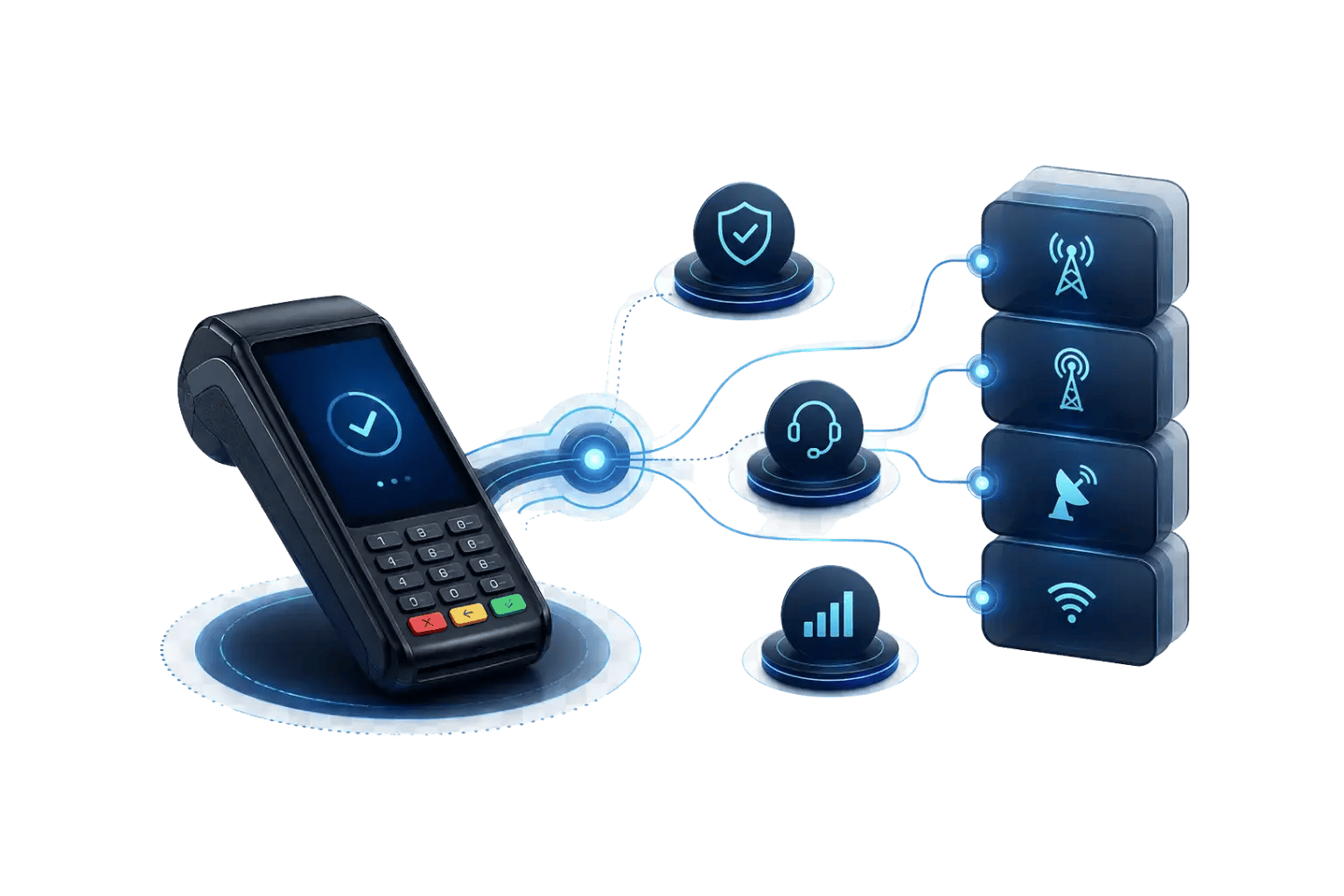
Quick Answer: Which POS Connectivity Model Fits Your Deployment?
Consider POND IoT when:
- You need connectivity customized around your terminals, routers or existing infrastructure.
- Business continuity is a primary requirement.
- You want access to multiple carrier networks.
- You want greater influence over carrier-selection policies.
- You require APIs, private networking or custom routing.
- You need both terminal-level connectivity and store-level failover.
- You want live technical support without being restricted to one hardware ecosystem.
- You support multiple terminal models, countries or deployment configurations.
Consider OptConnect when:
- You want the provider to handle most connectivity administration.
- You prefer preconfigured hardware and a standardized deployment process.
- You need hardware, connectivity, monitoring and support combined into one service.
- Your organization has limited internal cellular or networking resources.
- You value simplicity and reduced operational involvement over extensive customization.
Consider Granite when:
- POS continuity is part of a larger store-networking requirement.
- You need broadband, SD-WAN, cellular backup and network hardware.
- You want coordinated field installation across many locations.
- You need one provider to manage multiple store technologies.
- You operate a large retail, restaurant or hospitality network.
- You need application prioritization for POS and other critical systems
Three Leading POS Connectivity Models
POND IoT, OptConnect and Granite Telecommunications address different parts of the POS connectivity market.
POND is oriented toward customizable connectivity and customer control. OptConnect emphasizes a packaged managed-service model. Granite is strongest when POS continuity is part of a broader store-networking and infrastructure project.
The most appropriate provider depends on the deployment architecture, the customer’s internal resources and how much operational responsibility the provider is expected to assume.
| Provider | Primary POS Differentiator | Best-Suited Requirement |
|---|---|---|
| POND IoT | Customizable business-continuity architecture, multicarrier connectivity, customer-directed carrier selection, hardware flexibility, APIs, store-level failover, and 24/7 expert support | Payment providers, POS manufacturers, and merchants that want resilient connectivity, live technical support, operational control, and the flexibility to use compatible existing hardware |
| OptConnect | Fully managed POS connectivity, preconfigured hardware, device monitoring, private-network options, and 24/7 support | Organizations seeking a standardized managed service that minimizes internal connectivity administration and places more responsibility on the provider |
| Granite Telecommunications | Complete-store networking, managed broadband, SD-WAN, cellular backup, application prioritization, hardware, monitoring, and field services | Multi-location retailers and restaurant groups that need POS continuity as part of a broader managed store-networking and infrastructure deployment |
How the Providers Were Evaluated
This comparison focuses on publicly documented capabilities relevant to POS business continuity and distributed payment operations.
The evaluation considers:
- Primary and backup connectivity
- Multicarrier and multi-network access
- Automatic failover
- Live technical-support availability
- Managed monitoring
- Hardware flexibility
- Preconfigured equipment
- Customer control over carrier selection
- Embedded terminal connectivity
- Store-level internet backup
- APIs and remote administration
- Private APNs, VPNs and IP-addressing options
- SD-WAN and application prioritization
- Field installation
- International connectivity
- Public POS, retail and payment deployment information
The evaluation does not attempt to compare factors that cannot be consistently verified through public information, including:
- Actual network performance at a specific location
- Historical outage frequency
- Average support-response time
- Customer satisfaction
- Pricing competitiveness
- Contract flexibility
- Portal usability
- Typical implementation speed
Capabilities may vary by product, country, carrier, hardware and commercial agreement. Buyers should confirm the precise solution being proposed.
Editorial Disclosure
This guide is published by POND IoT, which is included in the comparison.
The assessment is based on publicly available product pages, technical information and case studies. Organizations should independently verify coverage, support terms, hardware compatibility, security requirements and commercial conditions before selecting a provider.
Why Business Continuity Matters for POS Systems
A POS terminal can appear operational while being unable to communicate with a processor, payment gateway or cloud-based application.
Connectivity may support:
- Payment authorization
- Transaction submission
- Tokenization
- Cloud POS access
- Inventory synchronization
- Pricing updates
- Loyalty programs
- Digital receipts
- Employee authentication
- Device-health reporting
- Remote configuration
- Software updates
- Order-management systems
- Accounting integrations
When connectivity fails, the operational effect can be immediate:
- Transactions cannot be completed.
- Checkout lines increase.
- Customers abandon purchases.
- Staff are forced into manual procedures.
- Unattended devices stop generating revenue.
- Store teams spend time troubleshooting connectivity.
- Inventory and transaction data become inconsistent.
Some payment systems can process a limited number of offline transactions. Others require an active connection before a transaction can be authorized.
The correct continuity design depends on the terminal, processor, merchant risk policy and operating environment.
The Two Layers of POS Business Continuity
POS connectivity generally involves one or both of the following layers.
Terminal-Level Connectivity
Cellular connectivity is embedded in or directly connected to an individual payment terminal.
Common examples include:
- Mobile POS devices
- Portable restaurant terminals
- Outdoor payment devices
- Food-truck payment systems
- Delivery payments
- Kiosks
- Self-checkout systems
- Unattended payment terminals
- Temporary retail terminals
A terminal-level solution should account for signal conditions, modem compatibility, carrier availability, SIM management and remote troubleshooting.
Store-Level Connectivity
Cellular connectivity provides primary or backup internet for the location.
This may support:
- Fixed checkout lanes
- Cloud-based POS systems
- Back-office applications
- Store routers
- Inventory systems
- Kiosks
- Digital signage
- Voice services
- Security systems
- Guest or operational Wi-Fi
A resilient deployment may use wired broadband as the primary connection and cellular service as automatic backup.
POND publicly supports primary cellular connectivity for mobile and distributed POS devices, as well as automatic failover for fixed POS environments.
POND IoT
Strongest for Customizable Business Continuity and Operational Control
POND is particularly well suited to payment companies, terminal manufacturers and merchants that need connectivity adapted around their deployment rather than delivered through one fixed hardware or service model.
Its capabilities include:
- Multicarrier connectivity
- Automatic network switching
- Primary cellular connectivity
- Store-level internet failover
- 24/7 expert support
- Customer-directed carrier selection
- Hardware flexibility
- Custom network configurations
- APIs and SIM lifecycle management
- Private APNs
- VPNs
- Static and private IP options
- Domestic and international connectivity
Where POND IoT Is Strongest
POND’s primary strength is the ability to combine resilient cellular connectivity with a high degree of customization.
The solution can be designed around:
- Embedded cellular modules
- Existing compatible routers
- Customer-selected hardware
- POND-supplied equipment
- Private-network requirements
- APIs
- Preferred and backup carriers
- Domestic or international deployments
- Terminal-level connectivity
- Complete-store failover
This makes POND relevant when the customer does not want connectivity constrained by a predefined appliance, fixed carrier policy or standardized deployment model.
Business Continuity Beyond Automatic Failover
Automatic failover can resolve some connectivity interruptions, but it cannot resolve every type of POS outage.
A failure may involve:
- The mobile carrier
- The primary broadband circuit
- A SIM configuration
- An APN
- A modem
- A router
- Antenna placement
- DNS or firewall settings
- A private network
- The terminal
- The processor or application
When switching networks does not restore service, the provider must help determine which part of the communication path is failing.
POND’s approach combines automated recovery options with access to live technical support.
Customer-Directed Carrier Selection
Many multicarrier services rely primarily on provider-controlled network-selection policies.
POND can give customers greater influence over which available carrier a device uses.
Carrier policies may be based on:
- Coverage at a merchant location
- Deployment testing
- Modem and radio-band compatibility
- Preferred and backup network policies
- Operational experience
- Geographic conditions
- Troubleshooting requirements
- Customer-defined network preferences
Available carriers still depend on the country, hardware and selected service.
Hardware Flexibility
POND does not require every POS deployment to use one proprietary hardware appliance.
Depending on compatibility, customers may use:
- Cellular modules embedded in terminals
- Existing approved routers
- Customer-selected networking equipment
- POND-supplied routers
- Single-device connections
- Store-level failover equipment
This is particularly useful for organizations that already have approved hardware or support multiple terminal and router models.
APIs and Connectivity Management
POND’s APIs and centralized management capabilities can support:
- SIM activation
- Suspension
- Status retrieval
- Usage monitoring
- Device grouping
- Provisioning
- Alerts
- Plan administration
- Platform integrations
- Operational automation
These functions may be incorporated into:
- Merchant onboarding
- Device logistics
- Terminal activation
- Internal support systems
- Customer portals
- Fleet-management platforms
- Replacement-device workflows
Private and Secure Connectivity
Available options can include:
- Private APNs
- VPNs
- Static IP addresses
- Private IP addressing
- Controlled routing
- Centralized access policies
- Global APN infrastructure
These capabilities can help establish controlled communication paths between payment devices and backend systems.
They do not independently make a payment deployment PCI DSS compliant. Compliance depends on the entire payment environment.
Particularly Well Suited For
POND is especially relevant for:
- POS manufacturers
- Payment processors
- Payment service providers
- Merchant acquirers
- Retail chains
- Restaurant groups
- Mobile POS operators
- Kiosk providers
- Self-checkout providers
- Unattended-payment operators
- Businesses supporting several terminal models
- Organizations requiring existing-hardware compatibility
- Domestic and international payment programs
When POND IoT May Be the Better Fit
POND may be the more appropriate choice when the buyer wants:
- Greater control over the connectivity architecture
- Flexibility to retain compatible hardware
- Customer-directed carrier policies
- Extensive API integration
- Both automated recovery and live support
- A design that can adapt across different merchant environments
- Connectivity that can scale across multiple countries or terminal types
OptConnect
Strongest for Standardized Managed POS Connectivity
OptConnect has a well-established public position in POS, payment terminals, self-checkout and unattended retail.
Its model is designed to reduce the amount of connectivity work handled by the customer.
Capabilities include:
- Managed cellular connectivity
- Preconfigured hardware
- Device monitoring
- Signal-strength visibility
- Usage reporting
- Private-network options
- 24/7 support
- SIM and eSIM services
- Multiple management levels
Where OptConnect Is Strongest
OptConnect is strongest when an organization wants a provider to manage a larger share of the connectivity lifecycle.
Its managed model can combine:
- Connectivity
- Preconfigured equipment
- Initial network configuration
- Monitoring
- Troubleshooting
- Secure networking
- Ongoing support
This may be particularly valuable for organizations that do not have dedicated cellular-networking resources.
Preconfigured Hardware
OptConnect offers managed hardware and equipment from established manufacturers.
This can simplify:
- Hardware selection
- Configuration
- SIM installation
- Deployment
- Monitoring
- Replacement
- Technical support
For customers prioritizing operational simplicity, a preconfigured appliance can reduce the amount of internal setup required.
Monitoring and Support
OptConnect publicly emphasizes monitoring and support capabilities such as:
- Device-health visibility
- Signal-strength monitoring
- Usage tracking
- Location labeling
- 24/7 support
- Phone and email assistance
The service is intended to place more responsibility for day-to-day connectivity operations on the provider.
Multiple Management Models
OptConnect offers more than one service model.
Depending on the selected service, customers may choose among:
- Fully managed connectivity
- Semi-managed connectivity
- Self-managed connectivity
Buyers should evaluate the specific proposal rather than assuming every OptConnect deployment has the same level of management or customization.
Particularly Well Suited For
OptConnect is especially relevant for:
- Organizations with limited internal IT resources
- Payment-device deployers
- Unattended-payment operators
- Kiosk providers
- Self-checkout systems
- Automated retail
- Businesses wanting preconfigured hardware
- Organizations preferring standardized deployment
- Customers seeking continuous monitoring
- Companies that want one provider to manage hardware and connectivity
When OptConnect May Be the Better Fit
OptConnect may be the more appropriate choice when the buyer wants:
- A packaged managed service
- Preconfigured hardware
- Reduced internal administration
- Continuous monitoring
- A standardized operating model
- The provider to assume greater responsibility for day-to-day connectivity management
Questions to Confirm
Organizations evaluating OptConnect should confirm:
- Which hardware is required
- Whether existing equipment can be retained
- Which carriers are available
- Who controls carrier selection
- Which APIs are included
- International coverage
- Private-network options
- Hardware ownership
- Replacement terms
- Which support and monitoring services are included
- The total cost of the selected management level
Granite Telecommunications
Strongest for Complete-Store Networking and Managed Infrastructure
Granite is particularly relevant when POS continuity is part of a broader store-networking requirement.
Its public service portfolio extends beyond individual payment terminals and includes:
- Broadband
- Cellular backup
- SD-WAN
- Routers
- Firewalls
- Wi-Fi
- LAN equipment
- Voice services
- Field installation
- Monitoring
- Telecom administration
This can make Granite a strong fit for national retailers, restaurants and hospitality organizations that want one provider to coordinate the complete location.
Where Granite Is Strongest
Granite is strongest when the customer needs to manage several technologies across many physical locations.
A store-level outage may affect:
- Cloud POS
- Checkout lanes
- Inventory systems
- Order-management applications
- Kiosks
- Security systems
- Digital signage
- Voice
- Guest Wi-Fi
- Staff communications
Granite’s model can combine primary internet, wireless backup, SD-WAN policies and managed hardware across the location.
SD-WAN and Application Prioritization
Granite’s managed-networking capabilities can support:
- Automatic cellular failover
- Primary-circuit restoration
- Application prioritization
- POS traffic protection
- Managed SD-WAN
- Network monitoring
- Centralized policy management
Application prioritization can be important when limited backup bandwidth must support POS traffic ahead of less critical applications.
Field Services
Granite can coordinate services such as:
- Site surveys
- Hardware sourcing
- Installation
- Testing
- Deployment scheduling
- Circuit coordination
- On-site troubleshooting
- Multi-location rollouts
This is particularly valuable when the project extends beyond a SIM or router and includes complete store infrastructure.
Managed Hardware and Infrastructure
Granite commonly delivers connectivity as part of a managed network environment.
That approach can benefit organizations seeking:
- Standardized store infrastructure
- Centralized accountability
- Coordinated installation
- Consistent configuration
- Ongoing monitoring
- One provider across wired and wireless services
Organizations that prioritize hardware independence should confirm which equipment and platforms are required.
Particularly Well Suited For
Granite is especially relevant for:
- National retailers
- Restaurant chains
- Grocery networks
- Hospitality groups
- Multi-location merchants
- Businesses requiring complete-store failover
- Organizations using SD-WAN
- Companies needing field installation
- Retailers consolidating multiple network providers
- Enterprises managing a large location footprint
When Granite May Be the Better Fit
Granite may be the more appropriate choice when the buyer wants:
- Complete-store networking
- Wired and wireless service consolidation
- Managed SD-WAN
- Cellular backup across locations
- POS application prioritization
- Hardware installation and field services
- A single provider coordinating multiple network technologies
Questions to Confirm
Organizations evaluating Granite should confirm:
- Required hardware
- SD-WAN platform
- Primary and backup carriers
- Failover and failback behavior
- Health-check methodology
- POS application prioritization
- API availability
- Embedded terminal-connectivity options
- Carrier-selection control
- Field-service coverage
- Support and escalation terms
- Hardware and platform portability
Comparing the Three Provider Models
| POS connectivity requirement | POND IoT | OptConnect | Granite Telecommunications |
|---|---|---|---|
| Primary service model | Customizable POS and IoT connectivity | Packaged managed device connectivity | Complete-store managed networking |
| Embedded terminal connectivity | Strong fit | Strong fit | Verify by solution |
| Store-level cellular failover | Strong fit | Available by solution | Core strength |
| Multicarrier connectivity | Core strength | Available by product | Available by configuration |
| Customer-directed carrier selection | Core differentiator | Confirm by product | Confirm by configuration |
| Existing-hardware flexibility | Core strength | Confirm by service model | Confirm by project |
| Preconfigured managed hardware | Available | Core strength | Core strength |
| Custom network architecture | Core strength | Available by service | Available within managed projects |
| APIs and connectivity automation | Core strength | Available | Varies by service |
| Managed monitoring | Limited; connectivity management and alerts available | Core strength | Core strength |
| SD-WAN and complete-store networking | Available through customized solutions | Not a primary focus | Core strength |
| Field installation and multi-site rollout | Available by project | Available by deployment | Core strength |
| Most closely aligned deployment | Organizations prioritizing customization, control, hardware flexibility and business continuity | Organizations seeking managed connectivity with reduced internal administration | Multi-location organizations requiring complete-store infrastructure and field services |
Which Provider Model Fits Each Requirement?
| POS connectivity requirement | Provider model most closely aligned |
|---|---|
| Customizable connectivity designed around terminals, routers and existing infrastructure | POND IoT |
| Customer-directed carrier selection and configurable network policies | POND IoT |
| Existing-hardware flexibility and hardware-independent deployment | POND IoT |
| APIs, private networking and custom provisioning workflows | POND IoT |
| Embedded terminal connectivity combined with store-level cellular failover | POND IoT |
| Packaged managed connectivity with reduced internal administration | OptConnect |
| Preconfigured managed routers, modems and cellular hardware | OptConnect |
| Provider-managed monitoring and day-to-day connectivity administration | OptConnect |
| Complete-store networking across broadband, cellular backup and SD-WAN | Granite Telecommunications |
| POS application prioritization and managed failover across retail locations | Granite Telecommunications |
| Coordinated field installation and multi-location network rollouts | Granite Telecommunications |
| Consolidation of wired, wireless and broader store-network services | Granite Telecommunications |
Choosing a Provider by Deployment Type
Fixed Retail Checkout
Fixed POS environments often depend on a store’s primary broadband connection.
A resilient design may include:
- Wired primary internet
- Cellular backup
- Automatic failover
- Multicarrier access
- Router health checks
- POS traffic prioritization
- Live technical support
Consider:
- POND IoT for customizable cellular failover and carrier flexibility
- OptConnect for a standardized managed cellular package
- Granite for complete-store networking and SD-WAN
Mobile POS
Mobile terminals may operate:
- Inside stores
- At restaurant tables
- Curbside
- At events
- In food trucks
- At temporary locations
- In the field
Important criteria include:
- Multicarrier access
- Indoor and outdoor coverage
- Modem compatibility
- Remote SIM management
- Carrier-selection options
- Support
- International connectivity
Consider:
- POND IoT when flexibility, carrier control and APIs are priorities
- OptConnect when preconfigured managed connectivity is preferred
Unattended Payments
Kiosks, vending machines, parking systems and self-checkout devices may operate without an employee present.
Important requirements include:
- Remote monitoring
- Multicarrier connectivity
- Automatic failover
- Private networking
- Usage alerts
- Remote troubleshooting
- After-hours support
- Hardware-replacement procedures
Consider:
- POND IoT for customizable unattended-device connectivity
- OptConnect for a standardized managed package
- Granite when the device is part of a broader site network
Restaurant POS
Restaurant operations may depend on connectivity for:
- Payment processing
- Online ordering
- Delivery platforms
- Kitchen systems
- Reservations
- Guest Wi-Fi
- Cloud POS
Consider:
- POND IoT for flexible connectivity and business-continuity design
- OptConnect for managed terminal connectivity
- Granite for complete restaurant-network infrastructure
Pop-Up and Temporary Retail
Temporary locations may require connectivity before wired service is available or where fixed internet is impractical.
Important criteria include:
- Rapid activation
- Portable hardware
- Local carrier availability
- Multicarrier connectivity
- Simple redeployment
- Usage visibility
- Support during operating hours
Consider:
- POND IoT for adaptable connectivity and reusable hardware options
- OptConnect for preconfigured managed equipment
- Granite when the temporary location requires broader site services
International POS Programs
International deployments should evaluate:
- Available networks by country
- SIM and eSIM formats
- Local and roaming connectivity
- Permanent-roaming restrictions
- Remote provisioning
- Routing architecture
- Private networking
- Support across time zones
Consider:
- POND IoT for customizable international deployments and network control
- OptConnect for a managed international connectivity model
- KORE or Telnyx where their specific enterprise or API capabilities align with the deployment
Other POS Connectivity Providers to Consider
The three primary providers represent different POS operating models. Other companies may be relevant for narrower requirements.
Telnyx
Relevant for API-First, Engineering-Led Deployments
Telnyx may be relevant to payment platforms and terminal manufacturers seeking:
- Programmable SIM management
- eSIM provisioning
- International network access
- Private networking
- Developer APIs
- Self-service control
It may be a good fit for technically self-sufficient teams that want to build connectivity into their own software and operating workflows.
KORE Wireless
Relevant for Large Enterprise IoT Programs
KORE may be relevant to multinational payment organizations seeking:
- Enterprise IoT connectivity
- Multi-country deployment
- Device testing
- Certification assistance
- Centralized SIM management
- Broader IoT lifecycle services
Buyers should verify the precise connectivity product, available networks, APIs and support model proposed for the POS deployment.
Hologram
Relevant for Development, Prototypes and Smaller Fleets
Hologram may suit:
- POS prototypes
- Product-development teams
- Mobile merchants
- Pop-up retail
- Smaller connected-device fleets
- Organizations preferring self-service activation
It may be less aligned with deployments that require extensive managed monitoring, hands-on continuity support or complete-store infrastructure.
Advantix
Relevant for Carrier Administration and Managed Wireless
Advantix may be relevant to organizations seeking:
- Managed multicarrier connectivity
- Wireless backup
- Temporary-store connectivity
- Hardware preparation
- Carrier administration
- Telecom expense management
Its broader focus is managed enterprise wireless and carrier administration rather than a dedicated embedded POS platform.
Technical Evaluation Checklist
Terminal and Modem Compatibility
Confirm:
- Cellular-module manufacturer and model
- Firmware version
- Supported LTE and 5G bands
- LTE-M requirements
- Carrier certifications
- SIM form factor
- MFF2 compatibility
- eSIM or eUICC support
- APN requirements
- Antenna design
- Remote modem-reset capability
Network Selection
Confirm:
- Available carriers
- Who controls network selection
- Manual selection options
- Automatic network-selection behavior
- Preferred-carrier policies
- Failover triggers
- Reattachment time
- Hardware-supported radio bands
- Country-specific roaming rules
Primary and Backup Architecture
Confirm:
- Whether cellular is primary or backup
- Wired-to-cellular failover behavior
- Cellular-to-cellular switching
- Health-check destinations
- Failure-detection interval
- Failover time
- Failback behavior
- Session persistence
- Offline-transaction support
- Remote alerts
- Manual override options
API Capabilities
Determine whether APIs support:
- SIM activation
- Suspension
- Deactivation
- Status retrieval
- Usage records
- Device grouping
- Plan changes
- Alerts
- Webhooks
- Profile provisioning
- Carrier preferences
- APN or IP configuration
- Merchant-onboarding integration
Payment and Backend Communications
Confirm:
- Payment-processor endpoints
- DNS requirements
- Required ports
- TLS requirements
- Persistent-session behavior
- NAT and CGNAT limitations
- Static-IP requirements
- Private-IP requirements
- VPN architecture
- Connection recovery
- Store-and-forward behavior
- Offline-authorization rules
Security
Evaluate:
- Private APNs
- VPNs
- Static and private IP addressing
- Traffic isolation
- Firewall policies
- SIM-to-device locking
- IMEI restrictions
- Access-control lists
- Encrypted communications
- Usage alerts
- Anomaly monitoring
- Remote SIM suspension
Connectivity is only one component of payment security. PCI DSS compliance depends on the complete cardholder-data environment.
Support and Incident Response
Confirm:
- Support hours
- Phone availability
- Weekend and holiday coverage
- Escalation procedures
- Network-operations access
- Hardware troubleshooting
- Carrier escalation
- Incident ownership
- Response targets
- Status communication
- Root-cause reporting
- Hardware-replacement procedures
The support model should be evaluated as part of the continuity architecture, not as a separate customer-service feature.
Questions to Ask Every POS Connectivity Provider
- Which carriers are available in each target market?
- Can we select or prioritize the carrier used by a device?
- How does automatic network switching work?
- Is cellular being used as primary connectivity, backup or both?
- Which terminals, modules and routers are supported?
- Can we retain existing compatible hardware?
- Which SIM and eSIM formats are available?
- Which APIs are included?
- Are private APNs, VPNs and static IPs available?
- What happens when automated failover does not restore service?
- Can technical support be reached outside normal business hours?
- Who owns escalation with the mobile carrier?
- How are SIM status, usage and alerts managed?
- What monitoring is included?
- Can the architecture support future countries and terminal models?
- Which services and equipment are included in the price?
- What happens to the hardware if the service changes?
- How are failed routers and devices replaced?
- What information is provided after an incident?
- How will the proposed design be tested before rollout?
Final Assessment
POND IoT, OptConnect and Granite Telecommunications are not interchangeable providers.
Each is strongest in a different part of the POS connectivity market.
- POND IoT is closely aligned with deployments that require customization, carrier control, hardware flexibility, APIs and business-continuity options across terminals and store networks.
- OptConnect is closely aligned with organizations seeking a standardized managed service that reduces internal connectivity administration.
- Granite Telecommunications is closely aligned with large multi-location organizations that need complete-store networking, SD-WAN, cellular backup and field services.
The right choice depends on several questions:
- Is connectivity embedded inside the terminal or supporting the entire location?
- Does the organization want to retain control over hardware and carrier policies?
- How much management should the provider assume?
- Are APIs and custom provisioning required?
- Is the project limited to connectivity, or does it include broadband, SD-WAN and installation?
- What happens when automatic failover does not resolve the problem?
- Who is responsible for restoring service?
The most appropriate provider is the one whose operating model matches the technical and organizational requirements of the deployment.
Frequently Asked Questions
No.
Different providers are suited to different deployment models.
POND is oriented toward customizable connectivity and operational control. OptConnect emphasizes standardized managed connectivity. Granite is strongest when POS continuity is part of a complete store-networking project.
POND may be appropriate when the deployment requires multicarrier connectivity, customer-directed carrier selection, hardware flexibility, APIs, private networking, live support or a customized continuity architecture.
OptConnect may be appropriate when the organization wants preconfigured hardware, managed monitoring, ongoing support and reduced internal connectivity administration.
Granite may be appropriate when the project includes broadband, cellular backup, SD-WAN, field installation and other complete-store network services.
POS systems may be unable to process transactions when the primary internet connection fails.
Cellular backup can help maintain access to payment processors, cloud POS platforms and other critical applications.
Not always.
Automatic failover can resolve some carrier and broadband interruptions. It may not resolve hardware failures, APN problems, firewall issues, configuration errors or payment-platform outages.
Some IoT SIM and eSIM products can access multiple carrier networks.
The available networks and selection method depend on the provider, SIM technology, modem and service configuration.
No.
Multicarrier connectivity means more than one network is available. Automatic failover refers to the process used to move a device or router to another connection after a problem is detected.
Yes.
A cellular router can provide backup internet for POS systems, inventory applications, kiosks and other critical systems when the primary connection fails.
No.
Private routing, VPNs and network isolation can support a secure architecture, but PCI DSS compliance depends on the complete payment environment.
Data usage depends on:
- Transaction volume
- Cloud POS activity
- Software updates
- Inventory synchronization
- Product downloads
- Remote monitoring
- Diagnostics
- Digital receipts
- Operating-system updates
Representative terminals should be tested before selecting a fleet-wide data plan.
Build the Right POS Connectivity Architecture
Every POS deployment has different terminals, locations, carriers, hardware, security requirements and continuity priorities.
POND can help evaluate:
- Embedded terminal connectivity
- Store-level cellular failover
- Multicarrier options
- Carrier-selection policies
- Existing hardware
- Private networking
- APIs and provisioning
- Domestic and international connectivity
- Support and escalation requirements

Multi-IMSI Connectivity for Cellular IoT
The landscape of Internet of Things (IoT) connectivity continues to evolve at a remarkable pace. The transformation from traditional methods of connectivity to more advanced, versatile solutions has been not just a technological leap, but a necessity driven by the demands of a rapidly changing world.
-1.png?width=300&name=Multi-IMSI_1200x1200%20(1)-1.png)
Is Your POS Connectivity Ready for an Outage?
Tell us about your terminals, locations, existing connectivity and business-continuity requirements. A POND connectivity specialist will help you evaluate multicarrier connectivity, cellular failover, hardware compatibility and support options for your deployment.