


Leading Digital Signage and Billboard Connectivity Providers
Comparing Digital Signage Connectivity Models by Deployment Need
Digital signage operators rarely begin with a provider shortlist.
They begin with a screen that stopped updating, a billboard that cannot be reached remotely, or a new location that has power but no practical way to install wired internet.
Those problems can look similar from the outside, but they often require different types of providers.
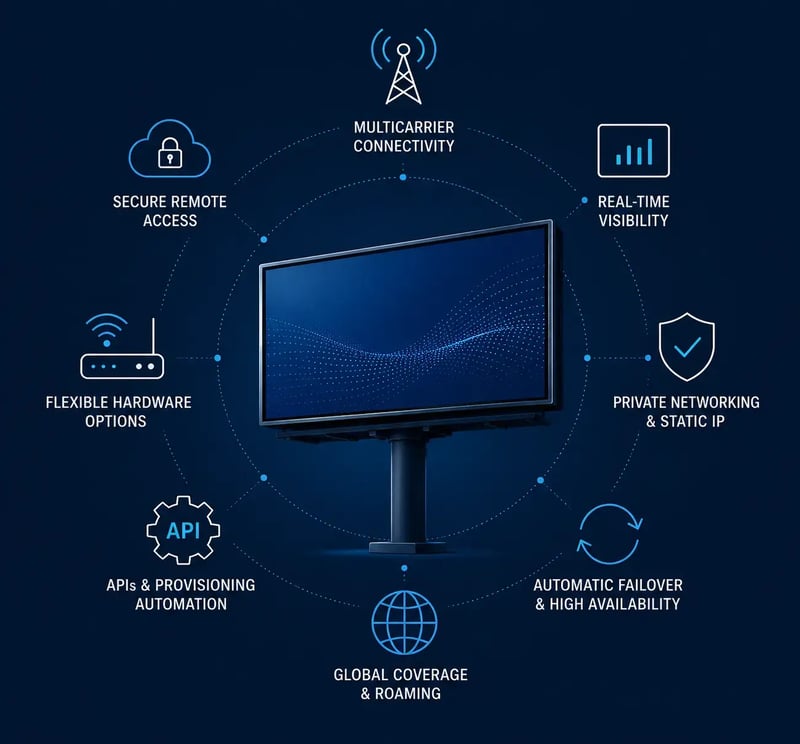
POND IoT is best suited to operators that want more control over the connectivity architecture, including hardware, carriers, APIs, private networking, and remote access.
OptConnect is built for organizations that prefer a more packaged service, with preconfigured cellular hardware, connectivity monitoring, and greater provider involvement in day-to-day operations.
Granite Telecommunications becomes relevant when digital signage is only one part of a broader store, restaurant, venue, or enterprise network involving broadband, SD-WAN, cellular backup, installation, and other managed infrastructure.
This is not a ranking. It is a comparison of three different operating models.
Quick Answer: Which Provider Model Fits Your Deployment?
Consider POND IoT when:
- You want connectivity designed around existing displays, media players, routers, or controllers.
- The cellular connection should remain independent from the content-management platform.
- You need access to multiple carrier networks.
- You want greater control over carrier selection and network policies.
- You require APIs, private APNs, VPNs, static IPs, or secure remote access.
- You operate a mixed fleet of indoor signs, outdoor billboards, menu boards, or kiosks.
- You want to retain compatible existing hardware.
- You need cellular as a primary connection, backup connection, or both.
- You want live technical support without adopting a fixed hardware ecosystem.
Consider OptConnect when:
- You want a more standardized cellular deployment.
- You prefer routers that arrive configured and ready to install.
- Your team does not want to manage cellular plans, APNs, hardware configuration, and carrier troubleshooting internally.
- Connectivity monitoring is important.
- You want one provider involved in hardware, service, and support.
- You are deploying many similar signs or screens.
- Speed and simplicity matter more than maximum architectural control.
Consider Granite when:
- Signage is one application on a larger site network.
- The location also depends on POS, Wi-Fi, cameras, voice, kiosks, or back-office systems.
- You need broadband, dedicated internet, SD-WAN, or cellular failover.
- National installation and field services are part of the project.
- You want to consolidate several network services under one provider.
- The objective is complete-site connectivity rather than connecting a standalone sign.
Digital Signage Connectivity Providers at a Glance
POND IoT, OptConnect and Granite Telecommunications address different digital-signage and billboard connectivity requirements.
POND is oriented toward flexible multicarrier connectivity, customer control and mixed hardware environments. OptConnect emphasizes a packaged managed-service model with preconfigured cellular equipment and monitoring. Granite is strongest when signage is part of a broader store, venue or enterprise network involving broadband, SD-WAN, cellular backup and field services.
The most appropriate provider depends on whether the organization is connecting individual signs, outsourcing cellular management or operating the complete location network.
| Provider | Primary Digital Signage Differentiator | Best-Suited Requirement |
|---|---|---|
| POND IoT | Customizable multicarrier connectivity, customer-directed carrier selection, hardware flexibility, APIs, private networking, secure remote access, cellular failover and 24/7 expert support | Digital billboard operators, DOOH networks, signage manufacturers and platform providers that want connectivity designed around existing displays, media players, routers, content systems and indoor or outdoor deployment requirements |
| OptConnect | Managed digital-signage connectivity, preconfigured cellular routers, private-network options, connection monitoring and ongoing support | Operators deploying similar screens, billboards or displays that want a standardized service with less internal hardware configuration, carrier administration and connectivity troubleshooting |
| Granite Telecommunications | Broadband, dedicated internet, managed SD-WAN, cellular backup, application prioritization, field installation and complete-site network management | Multi-location retailers, restaurants, venues and enterprises where digital signage shares network infrastructure with POS, Wi-Fi, cameras, voice, kiosks or other business systems |
How This Comparison Was Built
This guide focuses on publicly documented capabilities that affect real digital-signage and billboard deployments:
- Cellular primary and backup connectivity
- Multicarrier access
- Carrier-selection control
- Hardware flexibility
- Preconfigured routers
- APIs and provisioning
- Private APNs and VPNs
- Static and private IP options
- Secure remote access
- Connectivity monitoring
- Failover
- Broadband and SD-WAN
- Field installation
- Domestic and international deployment
- Technical support
- Public experience in digital signage, DOOH, retail, or managed networking
It does not attempt to score claims that cannot be compared consistently through public information, such as actual performance at a specific site, historical outage rates, support-response times, pricing, or customer satisfaction.
Coverage, throughput, hardware compatibility, monitoring scope, and support responsibilities should be verified directly with each provider.
Editorial Disclosure
This guide is published by POND IoT, which is included in the comparison.
The purpose is not to declare one provider universally superior. It is to show which service model is most appropriate for different signage environments.
Why Digital Signage Connectivity Fails in the Real World
A screen can remain powered on while becoming operationally useless.
The router may still appear connected, but the operator may no longer be able to:
- Publish new content
- Remove expired campaigns
- Confirm playback
- Reach the media player
- Restart equipment remotely
- Update software
- Retrieve proof-of-play records
- Change pricing or menus
- Diagnose a blank or frozen display
That distinction matters.
A connected router is not the same as a healthy screen.
The router may have an active cellular session while the media player is frozen, the content-management system is unreachable, or the display continues showing stale creative.
A signage outage may involve:
- Weak signal
- Carrier congestion
- Antenna placement
- A failed modem
- An incorrect APN
- A router fault
- A media-player problem
- DNS or firewall settings
- A content-platform outage
- Power instability
- A display controller
- The screen itself
That is why a connectivity proposal should explain more than the number of available networks.
Three Mistakes Signage Operators Commonly Make
Mistake 1: Treating Router Monitoring as Screen Monitoring
A provider may be able to confirm that the router is attached to the mobile network.
That does not prove that:
- The media player is reachable
- The display is powered on
- The correct campaign is playing
- The screen is not frozen
- Proof-of-play data is being recorded
Buyers should establish exactly what each platform monitors.
Mistake 2: Choosing a Carrier Before Testing the Site
The strongest national carrier is not automatically the strongest carrier at a particular billboard or indoor screen.
Performance depends on:
- Building materials
- Terrain
- Antenna placement
- Equipment enclosures
- Modem bands
- Local congestion
- The physical position of the sign
For outdoor billboards, the best carrier is the one that works at that structure with that hardware and antenna configuration.
Representative site testing should happen before a large rollout.
Mistake 3: Underestimating Data Usage
A basic menu board and a video-heavy DOOH display can have completely different data profiles.
Usage may increase because of:
- High-resolution video
- Frequent campaign changes
- Operating-system updates
- Remote viewing
- Software downloads
- Proof-of-play reporting
- Diagnostic uploads
- Content not being cached locally
A plan designed for low-data telemetry may be poorly suited to a signage network moving large media files.
POND IoT
Flexible Connectivity Built Around the Signage Network
POND is the strongest fit when connectivity needs to adapt to the signage deployment instead of forcing the deployment into one fixed carrier, router, or platform.
That is especially relevant for:
- Digital billboard operators
- DOOH media networks
- Signage manufacturers
- Content-platform providers
- Retail signage networks
- Digital menu boards
- Transit displays
- Temporary signage
- International signage programs
Keeping Connectivity Independent
A signage deployment often involves several vendors:
- Display manufacturer
- Media player
- Content-management system
- Router
- Connectivity provider
- Installer
- Monitoring platform
- Advertising platform
POND allows the connectivity layer to remain separate from the rest of that stack.
That can make it easier to:
- Change content platforms without replacing connectivity
- Support several media-player vendors
- Retain approved routers
- Connect different display types under one program
- Build custom provisioning workflows
- Expand into new markets
- Avoid dependence on the property owner’s network
For operators that value portability, this separation is important.
Multicarrier Connectivity With More Control
Signage assets are deployed in unpredictable radio environments.
A rural billboard may have only one strong carrier. An urban display may face congestion. An indoor screen may be installed behind concrete, steel, coated glass, or other materials that weaken signal.
POND provides access to multiple carrier networks and can give customers greater influence over which available network a device uses.
That matters when the operator already knows:
- Which carrier performs best at a location
- Which network should be preferred in a region
- Which carrier is experiencing a local issue
- Which modem bands are available
- Which backup network should be selected during troubleshooting
The value is not simply having more carrier names on a coverage list. It is having more practical recovery options.
Hardware Flexibility
POND does not require every deployment to use one proprietary appliance.
Depending on compatibility, the architecture can support:
- Existing routers
- Embedded cellular modules
- Customer-selected gateways
- POND-supplied hardware
- Media players with cellular capability
- Billboard controllers
- Menu boards
- Retail displays
- Kiosks
- Transit signs
This is particularly useful for networks that have grown through multiple hardware generations, acquisitions, or different installation partners.
APIs and Provisioning
For signage manufacturers and platform providers, connectivity often needs to fit into the deployment workflow.
POND APIs can support functions such as:
- SIM activation
- Suspension
- Status retrieval
- Usage monitoring
- Device grouping
- Alerts
- Plan administration
- Provisioning automation
- Platform integration
These capabilities can be tied into hardware staging, installation, screen onboarding, customer portals, support systems, and replacement workflows.
Private Networking and Remote Access
Signage operators often need secure access to routers, media players, or controllers.
Standard cellular service may place devices behind carrier-grade NAT, making direct inbound access difficult.
POND can support architectures using:
- Private APNs
- VPNs
- Static public IPs
- Private static IPs
- Controlled routing
- Device-specific access policies
The security design still needs proper authentication, firewall rules, credentials, and device hardening. A static IP by itself is not a security strategy.
Data Plans That Match the Content Model
Signage data requirements vary widely.
A static price board may use little data. A frequently updated digital billboard may download large video files, operating-system updates, and remote diagnostic sessions.
A flexible plan can account for:
- Content size
- Update frequency
- Local caching
- Seasonal traffic
- Proof-of-play reporting
- Software updates
- Remote viewing
- Temporary high-usage periods
Where POND Fits Best
POND is most closely aligned with deployments where:
- The operator wants control over the architecture.
- Multiple carrier options are important.
- Existing compatible hardware should be retained.
- Different screen and player types must be supported.
- APIs and custom provisioning are required.
- Secure remote access is needed.
- Connectivity should remain independent from the CMS.
- Indoor, outdoor, and international assets need one adaptable approach.
OptConnect
Managed Cellular Connectivity With Less Internal Work
OptConnect takes on more of the operational connectivity workload.
Its appeal is straightforward: the operator can receive configured hardware, deploy it, and rely on the provider for more of the monitoring, troubleshooting, and ongoing management.
This can be valuable for signage networks that want a repeatable package rather than a highly customized architecture.
Where the Managed Model Helps
OptConnect can reduce work around:
- Router selection
- SIM installation
- Cellular configuration
- APN setup
- Deployment testing
- Monitoring
- Carrier troubleshooting
- Equipment replacement
- Support
For an operator rolling out hundreds of similar displays, standardization can be more valuable than having control over every technical detail.
Preconfigured Hardware
A router that arrives ready for installation can shorten deployment time and reduce configuration mistakes.
This model is particularly useful when:
- Many sites use the same architecture
- Installers need a repeatable process
- The operator has limited networking staff
- Signs must go live quickly
- Hardware replacement needs to be simple
Connectivity Monitoring
OptConnect places strong emphasis on managed monitoring.
That may include visibility into:
- Router status
- Cellular attachment
- Signal condition
- Data usage
- Device location
- Connectivity events
- Support history
The important question is where that monitoring stops.
A provider may monitor the router without monitoring the media player, CMS connection, display power, or actual screen output.
That boundary should be established before deployment.
The Main Trade-Off
A packaged service can reduce internal workload, but it may also limit control over hardware, carrier policies, and network configuration.
Buyers should confirm:
- Whether existing routers can be retained
- Which carriers are available
- Who controls network selection
- Which remote-access options are supported
- Which APIs are included
- Who owns the hardware
- How replacements are handled
- Whether the deployment can be transferred later
- Whether the data plan supports video-heavy use
Where OptConnect Fits Best
OptConnect is most closely aligned with deployments where:
- Preconfigured hardware is preferred.
- Internal cellular expertise is limited.
- Monitoring should be included.
- Similar signs are deployed repeatedly.
- One provider should handle hardware and connectivity.
- Deployment simplicity matters more than maximum flexibility.
Granite Telecommunications
Complete-Site Networking Rather Than Standalone Sign Connectivity
Granite solves a broader problem.
It is not primarily a billboard-first or embedded-device provider. It becomes relevant when signage is one application on a complete location network.
That might include:
- Retail stores
- Restaurants
- Entertainment venues
- Hospitality properties
- Transportation facilities
- Corporate campuses
- Multi-location enterprises
At these sites, the network may also support:
- POS
- Wi-Fi
- Cameras
- Voice
- Kiosks
- Security systems
- Back-office applications
- Staff devices
The requirement is no longer just “connect the screen.”
It becomes a broader networking project.
Broadband, SD-WAN, and Cellular Backup
Granite is most useful when the location needs some combination of:
- Primary broadband
- Dedicated internet
- SD-WAN
- Cellular failover
- Application prioritization
- LAN equipment
- Monitoring
- Field installation
- One support relationship
This is particularly relevant for digital menu boards, retail signage, and venue networks where several systems depend on the same infrastructure.
High-Bandwidth Signage
Some signage environments move more data than a typical cellular IoT deployment.
Examples include:
- Frequent video updates
- Large creative packages
- Remote-viewing streams
- Software images
- Live or near-live content
- Several screens sharing one connection
In those cases, fixed broadband or dedicated internet may be more appropriate as the primary service, with cellular reserved for backup.
Field Services
National rollouts can involve much more than shipping a router.
A project may require:
- Site surveys
- Circuit coordination
- Cabling
- Router installation
- LAN changes
- Testing
- Technician dispatch
- Multi-vendor scheduling
- Documentation
- Ongoing support
Granite is strongest when these site-level responsibilities are central to the project.
The Main Trade-Off
Granite may be unnecessarily broad for a standalone digital billboard that only needs one cellular connection.
It becomes more attractive when:
- Several business systems share the site
- Wired service is required
- Field installation is substantial
- The buyer wants service consolidation
- The complete network must be managed as infrastructure
Where Granite Fits Best
Granite is most closely aligned with deployments where:
- Signage is part of a complete store or venue network.
- Wired and wireless connectivity must be combined.
- SD-WAN or application prioritization is needed.
- National installation services matter.
- Several location technologies need one provider.
- Consolidation matters more than device-level flexibility.
Comparing the Three Provider Models
| POS connectivity requirement | POND IoT | OptConnect | Granite Telecommunications |
|---|---|---|---|
| Primary service model | Customizable POS and IoT connectivity | Packaged managed device connectivity | Complete-store managed networking |
| Embedded terminal connectivity | Strong fit | Strong fit | Verify by solution |
| Store-level cellular failover | Strong fit | Available by solution | Core strength |
| Multicarrier connectivity | Core strength | Available by product | Available by configuration |
| Customer-directed carrier selection | Core differentiator | Confirm by product | Confirm by configuration |
| Existing-hardware flexibility | Core strength | Confirm by service model | Confirm by project |
| Preconfigured managed hardware | Available | Core strength | Core strength |
| Custom network architecture | Core strength | Available by service | Available within managed projects |
| APIs and connectivity automation | Core strength | Available | Varies by service |
| Managed monitoring | Limited; connectivity management and alerts available | Core strength | Core strength |
| SD-WAN and complete-store networking | Available through customized solutions | Not a primary focus | Core strength |
| Field installation and multi-site rollout | Available by project | Available by deployment | Core strength |
| Most closely aligned deployment | Organizations prioritizing customization, control, hardware flexibility and business continuity | Organizations seeking managed connectivity with reduced internal administration | Multi-location organizations requiring complete-store infrastructure and field services |
Which Provider Model Fits Each Requirement?
| Digital signage connectivity requirement | Provider model most closely aligned |
|---|---|
| Connectivity designed around existing displays, media players, routers and content platforms | POND IoT |
| Customer-directed carrier selection and configurable network policies | POND IoT |
| Multicarrier connectivity across indoor, outdoor, remote and high-congestion locations | POND IoT |
| Existing-hardware flexibility across mixed display, router and media-player environments | POND IoT |
| Connectivity independent from the content-management or digital-signage platform | POND IoT |
| APIs, private networking, static IP options and custom provisioning workflows | POND IoT |
| Secure remote access to routers, media players and billboard controllers | POND IoT |
| Packaged managed digital-signage connectivity with reduced internal administration | OptConnect |
| Preconfigured managed cellular routers and repeatable installation workflows | OptConnect |
| Provider-managed router monitoring and day-to-day connectivity troubleshooting | OptConnect |
| Standardized deployments across similar billboards, menu boards and digital displays | OptConnect |
| Complete-store, restaurant or venue networking that includes digital signage | Granite Telecommunications |
| Broadband or dedicated internet for high-bandwidth signage and video distribution | Granite Telecommunications |
| Managed SD-WAN, cellular backup and application prioritization across locations | Granite Telecommunications |
| National field installation, circuit coordination and multi-site network rollouts | Granite Telecommunications |
| Consolidation of signage, POS, Wi-Fi, cameras, voice and other site infrastructure | Granite Telecommunications |
This table maps common digital-signage and billboard requirements to the provider model most closely aligned with each need. It is not a ranking of overall reliability, support quality or value. Actual capabilities may vary by product, location, carrier, hardware, configuration and commercial agreement.
Choosing by Deployment Type
Outdoor Billboards and DOOH
Outdoor displays often need:
- Cellular primary connectivity
- Multicarrier options
- Remote controller access
- Strong antenna design
- Reliable content updates
- Appropriate data allowances
- Remote troubleshooting
POND is the stronger fit when the operator wants carrier flexibility, hardware independence, and a customized remote-access architecture.
OptConnect is a strong fit when the operator prefers a managed router package and connectivity monitoring.
Granite is less likely to be the first choice for a standalone roadside billboard unless the project includes fixed access, field construction, or broader site infrastructure.
Indoor Retail Signage and Menu Boards
Indoor signage may share a network with POS, Wi-Fi, cameras, and other store systems.
POND works well when the signage operator wants an independent cellular connection that does not rely on the retailer’s network.
OptConnect works well when the operator wants a packaged cellular deployment.
Granite becomes relevant when signage is part of the complete store or restaurant network.
Transit and Transportation Displays
Transit signage is widely distributed and may operate in difficult RF environments.
POND is well suited to mixed hardware, multicarrier access, and custom remote management.
OptConnect is appropriate when standard hardware and managed connectivity are preferred.
Granite becomes more relevant when displays share infrastructure with several systems at the transit location.
Temporary and Event Signage
Temporary assets often need to go live before wired service is available.
POND provides more flexibility over hardware, carriers, and redeployment.
OptConnect offers a simpler packaged option.
These two models are generally more relevant than complete-site networking for short-term deployments.
International Signage Networks
International deployments introduce carrier differences, roaming restrictions, hardware-band requirements, routing concerns, and support across time zones.
POND is well suited to operators that want one adaptable architecture across countries.
OptConnect may suit buyers who prefer a managed international service.
KORE Wireless may also be relevant where signage is one device category in a much larger multinational IoT estate.
Other Connectivity Providers to Consider
KORE Wireless
KORE may be relevant to large global signage manufacturers or enterprises seeking centralized SIM management across countries and device categories.
It is less signage-specific than POND or OptConnect, but can be suitable when digital signage is part of a broader global IoT program.
Telnyx
Telnyx may appeal to engineering-led teams that want programmable SIM management, eSIM, private networking, developer APIs, and self-service control.
It is better suited to organizations prepared to build more of the connectivity workflow themselves.
Hologram
Hologram may be relevant for prototypes, small fleets, product development, and temporary installations.
It is less naturally aligned with networks requiring extensive managed monitoring or enterprise field services.
Advantix
Advantix may be relevant when carrier administration, hardware preparation, wireless-service management, and expense control are central priorities.
Its position is broader managed enterprise connectivity rather than digital-signage specialization.
Connectivity Providers and Signage Platforms Are Not the Same
A complete signage deployment may include:
- Content-management software
- Media players
- Displays
- Billboard controllers
- Proof-of-play systems
- Programmatic advertising platforms
- Audience measurement
- Installation and maintenance
The signage platform determines what content plays and when.
The connectivity provider supplies the network path used to distribute content, monitor devices, and support remote access.
Those functions may be bundled, but they should not be treated as interchangeable.
Keeping the connectivity layer independent can improve portability and hardware choice. Using a more integrated platform can simplify operations.
The right model depends on how much control the operator wants to retain.
Technical Evaluation Checklist
Hardware and Radio Compatibility
Confirm:
- Display and media-player models
- Router or modem model
- Firmware version
- Ethernet, Wi-Fi, or embedded cellular interface
- Supported LTE and 5G bands
- Carrier certifications
- SIM format
- eSIM or eUICC support
- Antenna type and placement
- Enclosure materials
- Environmental operating range
Content and Data Usage
Estimate:
- Image and video file sizes
- Campaign update frequency
- Software-update size
- Proof-of-play traffic
- Monitoring traffic
- Remote-viewing requirements
- Local caching
- Expected monthly usage
- Peak download requirements
Coverage and Carrier Selection
Confirm:
- Available carriers at representative sites
- Indoor and outdoor signal conditions
- Who controls network selection
- How switching works
- Whether the router supports all necessary bands
- Antenna-placement options
- International roaming restrictions
Failover and Recovery
Confirm:
- Whether cellular is primary or backup
- How failures are detected
- What triggers switching
- Reconnection behavior
- Failback behavior
- Remote router-reset capability
- Manual carrier-selection options
- Whether the media player reconnects automatically
- Who investigates when failover does not restore service
Remote Access and Security
Evaluate:
- Private APNs
- VPNs
- Static public IPs
- Private static IPs
- Outbound management tunnels
- Firewall rules
- Device authentication
- Access-control lists
- Secure software updates
Monitoring Boundaries
Clarify whether the provider monitors:
- SIM status
- Cellular attachment
- Router health
- WAN availability
- Ethernet connection
- Media-player reachability
- CMS connectivity
- Display power
- Screen output
- Proof of play
Support Responsibilities
Confirm:
- Support hours
- Phone availability
- Carrier escalation
- Router troubleshooting
- Media-player troubleshooting
- Field-service availability
- Hardware replacement
- Incident ownership
- Root-cause reporting
- Responsibility boundaries between vendors
Questions to Ask Every Provider
- Which carriers are available at each target site?
- Can the sign use more than one network?
- Who controls carrier selection?
- Can existing routers and media players be retained?
- Is cellular intended as primary service, backup, or both?
- Can the plan support the expected content traffic?
- Which APIs are included?
- Are private APNs, VPNs, and static IPs available?
- Can the media player or controller be reached remotely?
- What does the monitoring actually cover?
- Can the provider distinguish a network outage from a media-player failure?
- Who escalates problems to the mobile carrier?
- How are failed routers replaced?
- How will representative locations be tested?
- Can the same architecture support indoor and outdoor signs?
- What happens when automatic switching does not restore service?
- Who owns the hardware?
- What happens if the operator later changes providers?
Final Assessment
POND IoT, OptConnect, and Granite Telecommunications solve different versions of the digital-signage connectivity problem.
POND IoT is the strongest fit when the operator wants a flexible connectivity layer with multicarrier access, customer-directed network selection, existing-hardware support, APIs, private networking, and secure remote access.
OptConnect is the strongest fit when the operator wants a standardized cellular service built around preconfigured equipment, monitoring, and reduced internal administration.
Granite Telecommunications is the strongest fit when signage is part of a broader location network involving broadband, SD-WAN, cellular backup, field installation, and other site infrastructure.
The most useful buying question is not:
Which provider is best?
It is:
Are we connecting the sign, outsourcing the cellular service, or managing the complete location network?
That distinction usually makes the right provider model clear.
Frequently Asked Questions
No.
POND emphasizes flexible cellular architecture and customer control. OptConnect emphasizes managed cellular service. Granite emphasizes complete-site network infrastructure.
POND is a strong fit when the deployment requires multicarrier connectivity, carrier control, hardware flexibility, APIs, private networking, remote access, or independence from the signage software platform.
OptConnect is a strong fit when the operator wants preconfigured routers, managed monitoring, support, and less internal responsibility for cellular connectivity.
Granite is a strong fit when signage is one application on a broader location network requiring broadband, SD-WAN, cellular backup, installation, and centralized service management.
Cellular allows signs to operate without relying on the host location’s Wi-Fi or wired network.
It can also reduce deployment delays at outdoor, temporary, remote, and third-party locations.
No.
Many signage deployments operate effectively on 4G LTE, especially when content is cached locally and updates are scheduled.
The decision should be based on coverage, bandwidth, hardware, and content requirements rather than using 5G by default.
No.
Router monitoring shows whether the network equipment is connected.
Screen monitoring may require separate software or hardware to confirm that the display is powered on and showing the correct content.
Usage depends on content size, video resolution, update frequency, software downloads, remote viewing, proof-of-play reporting, and local caching.
A static menu board may use relatively little data. A frequently updated video display may use substantially more.
Build the Right Connectivity Architecture for Your Signage Network
Every signage deployment has different displays, media players, routers, locations, data requirements, and support responsibilities.
POND can help evaluate:
- Multicarrier connectivity
- Indoor and outdoor signage
- Digital billboards and DOOH
- Existing routers and media players
- Carrier-selection policies
- Cellular primary and backup service
- Private APNs and VPNs
- Static and private IP addressing
- Secure remote access
- APIs and provisioning
- Domestic and international deployment
- Data-plan requirements
- Support and escalation procedures

Multi-IMSI Connectivity for Cellular IoT
The landscape of Internet of Things (IoT) connectivity continues to evolve at a remarkable pace. The transformation from traditional methods of connectivity to more advanced, versatile solutions has been not just a technological leap, but a necessity driven by the demands of a rapidly changing world.
-1.png?width=300&name=Multi-IMSI_1200x1200%20(1)-1.png)
Can You Still Reach Every Screen When the Primary Network Fails?
Tell us about your displays, media players, locations, content-update requirements, and current connectivity challenges. A POND connectivity specialist will help you evaluate carrier options, hardware compatibility, data usage, failover, private networking, and remote-access requirements.