


Top Agriculture Connectivity Providers
Comparing Smart-Agriculture IoT Programs, Flexible Rural Connectivity and Enterprise Farm Infrastructure
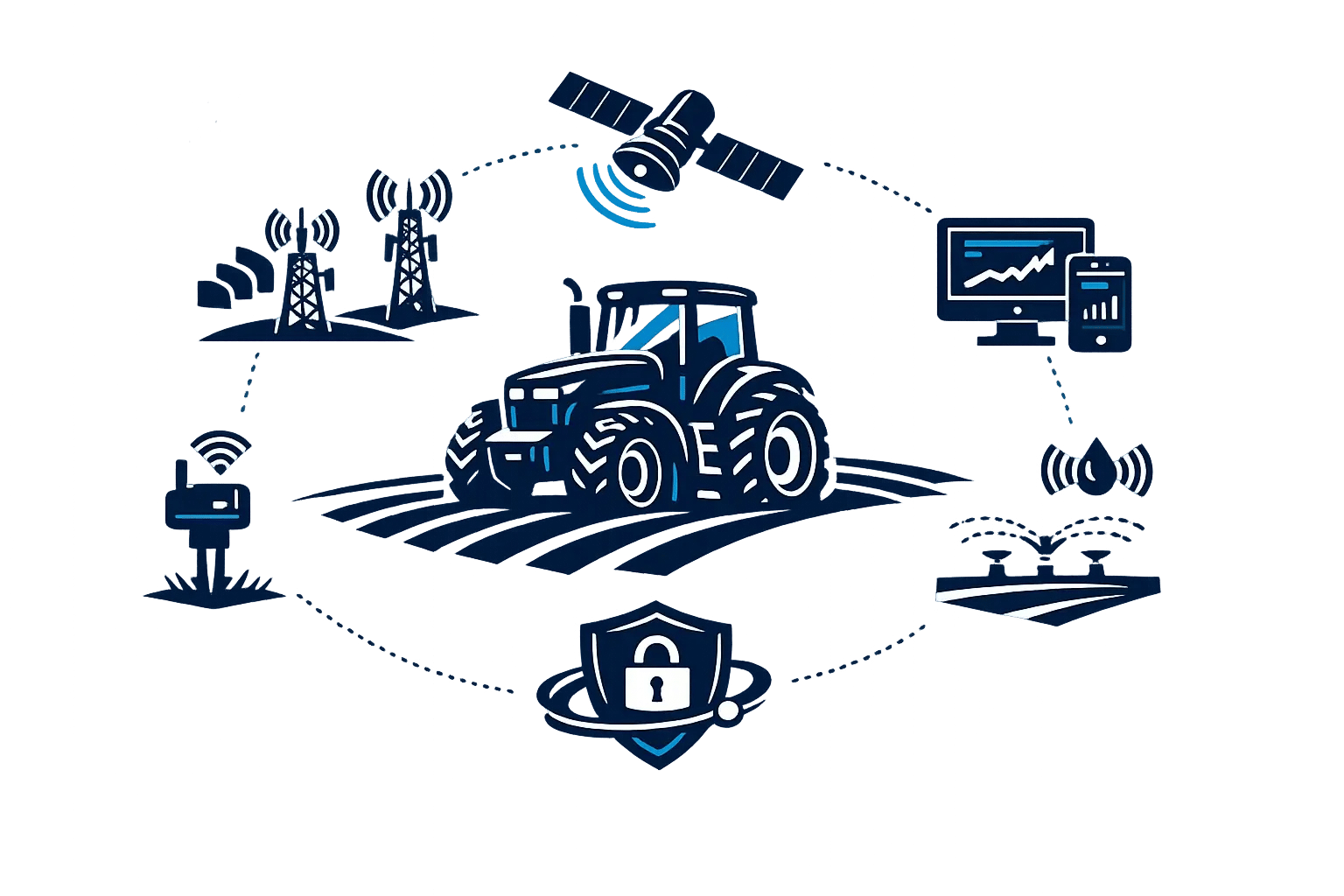
Agricultural connectivity problems rarely begin at the farmhouse.
They usually begin at the edge of a field, inside a metal building, beside a pump station or on equipment that has moved into a different carrier footprint.
That is what makes agriculture a difficult IoT environment. The devices may be relatively simple, but the network conditions are not.
A soil sensor may send only a few kilobytes a day. A camera may upload video. A tractor may move continuously across several coverage areas. An irrigation controller may barely use any data but still be operationally critical if it becomes unreachable.
Modern agricultural operations may need to connect:
- Soil and environmental sensors
- Weather stations
- Irrigation controllers
- Pumps
- Livestock-monitoring devices
- Tractors and other mobile equipment
- Grain and feed monitoring systems
- Cameras
- Remote gateways
- Warehouses
- Processing facilities
- Farm offices
Those systems do not have the same requirements, and they should not automatically use the same connectivity architecture.
This guide compares three providers that approach the problem differently:
- KORE Wireless combines global IoT connectivity with smart-agriculture experience, device services and broader deployment support.
- POND IoT provides flexible multicarrier cellular and global eSIM connectivity for agricultural equipment, sensors and gateways that need to operate across inconsistent carrier environments.
- Granite Telecommunications supports the offices, warehouses, processing facilities, retail locations and other fixed infrastructure surrounding larger agricultural enterprises.
The important question is not simply which provider operates in agriculture.
It is:
What part of the agricultural connectivity problem does the organization actually need solved?
Quick Answer: Which Agriculture Connectivity Provider Fits Best?
KORE Wireless
Best for Broader Smart-Agriculture IoT Programs
KORE is a strong fit when connectivity is only one part of a larger connected-agriculture deployment.
Its agriculture portfolio includes use cases involving soil conditions, weather, water usage, crop health and livestock monitoring. KORE also provides global IoT connectivity and broader device-enablement services such as testing, certification, deployment preparation and lifecycle support.
That model is particularly relevant for AgTech companies and larger agricultural programs that do not want to assemble every part of the IoT stack themselves.
A typical requirement sounds like:
“We need more than connectivity. We want support across devices, deployment and ongoing IoT operations.”
POND IoT
Best for Farms and AgTech Deployments Where Network Conditions Change
A farm can have several usable cellular networks and still have dead spots.
The best carrier near the farmhouse may not be the best carrier near the grain bins, the far irrigation zone or the equipment operating several miles away.
This is where POND is most differentiated.
POND provides multicarrier cellular, global eSIM and centralized connectivity management for compatible sensors, gateways, trackers and agricultural equipment. It is especially relevant when an organization already has selected its hardware and application and does not want connectivity tied to a fixed device or software ecosystem.
A typical requirement sounds like:
“We know which equipment and sensors we want to use. We need the cellular layer to work across places where one carrier does not.”
Granite Telecommunications
Best for the Fixed Infrastructure Around Large Agricultural Operations
Granite fits a different part of the agricultural environment.
Its role becomes clearer when the organization operates processing plants, warehouses, cold-storage facilities, feed mills, farm offices, retail locations or distribution sites in addition to field equipment.
Those locations may need internet, wireless backup, Wi-Fi, cabling, mobile-device administration and onsite technical support.
A typical requirement sounds like:
“Our agricultural operation has grown into a distributed enterprise, and the facilities behind it need to be standardized and supported.”
Granite is therefore most relevant to the business infrastructure surrounding connected agriculture rather than to individual field sensors.
Agriculture Connectivity Providers at a Glance
KORE, POND and Granite address different parts of the agriculture connectivity problem.
KORE combines connectivity with broader smart-agriculture and device-enablement services. POND focuses on adaptable connectivity for compatible sensors, gateways and equipment operating across inconsistent carrier environments. Granite supports the facilities and enterprise network surrounding larger agricultural organizations.
| Provider | Primary Agriculture Connectivity Differentiator | Best-Suited Requirement |
|---|---|---|
| KORE Wireless | Global IoT connectivity combined with smart-agriculture experience, device enablement, testing, certification, centralized administration, deployment preparation and broader lifecycle support | AgTech providers and agricultural organizations that want connectivity coordinated with devices, deployment services and a broader connected-agriculture program |
| POND IoT | Flexible multicarrier cellular and global eSIM connectivity, compatible-hardware support, configurable network policies, centralized SIM management, APIs, private networking, static IP options, secure remote access and direct technical guidance | Farms, equipment manufacturers and AgTech companies that already have—or want to select—their own sensors, gateways, controllers and applications and need adaptable connectivity across rural and remote environments |
| Granite Telecommunications | Managed networking, mobility administration, wireless backup, equipment rollout, field services and service-provider consolidation across distributed enterprise locations | Large agricultural enterprises that need processing facilities, warehouses, cold-storage sites, offices, retail locations and other fixed operations standardized and supported as a consistent communications environment |
How This Comparison Was Built
Agriculture is not one connectivity use case.
A solar-powered weather station has almost nothing in common with a connected tractor. A pump controller may use very little data but be operationally critical. A camera may consume more bandwidth in one day than hundreds of soil sensors.
This comparison focuses on the parts of the deployment that materially change the connectivity decision:
- Rural carrier availability
- Multicarrier behavior
- Global eSIM
- Existing-hardware compatibility
- Low-power devices
- Mobile equipment
- Irrigation and pump control
- Environmental monitoring
- Livestock systems
- Agricultural gateways
- Remote access
- Private networking
- Device deployment
- Facility networking
- Mobility management
- Long hardware lifecycles
Performance still depends on the actual modem, antenna, installation, terrain, vegetation, power source, firmware and available networks.
Editorial Disclosure
This guide is published by POND IoT, which is included in the comparison.
KORE is evaluated around broader smart-agriculture and IoT deployment programs. POND is evaluated around flexible connectivity for compatible agricultural devices and remote operations. Granite is evaluated around the enterprise infrastructure surrounding larger agricultural organizations.
Agriculture Has a Coverage Problem That Maps Do Not Fully Explain
A nationwide carrier map may show an entire farming region as covered.
That does not mean every field, barn, valley or pump station behaves the same way.
Agricultural operations can span:
- Hills and valleys
- Tree lines
- Metal buildings
- Grain bins
- Remote acreage
- Irrigation zones
- Equipment routes
- Livestock areas
The useful network can change within the same property.
This creates a very different problem from connecting a restaurant, branch office or warehouse. At a fixed commercial site, an installer can identify the best available carrier and design around it.
A combine or service vehicle may move through several different coverage conditions in one day. Even stationary sensors can end up in locations where the preferred carrier performs poorly.
For agriculture, the question is less:
“Which carrier covers this county?”
and more:
“Which networks work where this device actually operates?”
A Connected Farm Is Really Several Different Networks
A modern farm may contain multiple connectivity environments at the same time.
The office may need business broadband and wireless backup.
A weather station may transmit a few measurements every hour.
A livestock device may need to preserve battery for months.
A tractor may generate machine telemetry while moving across large acreage.
A camera may require a reliable uplink and substantially more data.
An irrigation controller may use almost no bandwidth but still need dependable remote access.
Those are different network problems.
Trying to force every device into the same connectivity model usually creates unnecessary compromises.
The better approach is to design around the job each system performs.
Where Agricultural Connectivity Breaks in Practice
At the Edge of the Farm
This is where a device moves outside the strongest footprint of the carrier chosen during installation.
It is particularly relevant for tractors, mobile equipment and distributed sensors.
A connection that works well near the equipment building may behave very differently several miles away.
Inside Metal Structures
Barns, machinery buildings, grain bins and processing structures can significantly affect radio performance.
A gateway tested outside the building may not behave the same way once installed inside it.
External antennas, placement and modem characteristics often matter as much as the service plan.
After the Environment Changes
Agricultural environments are not static.
Vegetation grows. Equipment is relocated. Temporary structures appear. Fields change through the season.
A location that had clean RF conditions during installation may behave differently later in the year.
That is one reason agricultural IoT should be validated over real operating conditions rather than through a one-time signal test.
When the Device Looks Online but the Farm Process Is Not Working
A cellular session can remain active while the actual agricultural system has failed.
Examples:
- A weather station is connected, but the rain sensor is blocked.
- An irrigation controller is online, but a valve did not open.
- A livestock gateway is attached to the network, but its downstream devices stopped reporting.
- A grain monitor is connected, but its reading is stale.
“Connected” and “working” are not the same operational state.
When Equipment Outlives the Network It Was Designed For
Agricultural hardware often remains in service far longer than consumer devices.
That means modem lifecycles and carrier network transitions matter.
A gateway installed today may still be expected to work years from now, so the deployment needs a plan for:
- Network sunsets
- Firmware updates
- Modem replacement
- eSIM or SIM migration
- Long-term hardware compatibility
Five Mistakes Companies Make With Smart-Agriculture Connectivity
1. Selecting the Carrier From the Farm Office
The office is often the easiest place to connect.
It is also frequently the least representative.
The harder locations may be:
- A remote pump
- A cattle pasture
- A grain bin
- A distant field
- A piece of mobile equipment
Coverage should be tested where the device will operate, not only where the installer happens to be standing.
2. Treating Coverage as a Yes-or-No Question
A farm may technically have service from one carrier across most of the property and still have several areas where that service is unusable.
This is where multicarrier architecture can become valuable.
The relevant question is not simply whether another network exists.
It is whether the hardware can use it effectively and recover when conditions change.
3. Assuming Every Agricultural IoT Device Is Low Bandwidth
Many sensors are.
Not all agriculture IoT is.
Remote cameras, machine telemetry, edge gateways, drone-related systems and diagnostic applications can use substantially more data than simple environmental sensors.
Bandwidth and data-plan design should follow the application rather than the label “smart agriculture.”
4. Ignoring Power Consumption During Poor Coverage
A battery-powered device does not use energy only when it transmits.
Repeated network searching, registration attempts and poor RF conditions can also affect power consumption.
That matters for:
- Solar-powered stations
- Remote sensors
- Livestock devices
- Battery-operated trackers
A device expected to last years on paper may perform very differently in marginal coverage.
5. Designing Everything Around Cellular Even When the Geography Says Otherwise
Cellular makes sense across much of agricultural IoT.
But there are farms, ranches and remote sites where useful terrestrial coverage simply does not exist.
In those cases, satellite or another communication path may be appropriate for selected devices.
The goal is not to choose cellular or satellite as an ideology.
It is to match the communication method to the location, data requirement and economics.
KORE Wireless
Smart Agriculture as a Broader IoT Program
KORE has a well-developed smart-agriculture portfolio covering environmental monitoring, crop conditions, water usage, livestock and connected equipment.
That makes KORE particularly relevant to companies building an agricultural IoT product or deploying connected devices across multiple regions.
The appeal is broader than the SIM itself.
A large deployment may also need help with:
- Device selection
- Connectivity
- Testing
- Certification
- Provisioning
- Deployment logistics
- International expansion
- Lifecycle management
KORE can address several of those layers within the same relationship.
Where That Model Helps
Consider an AgTech manufacturer preparing to ship the same connected device into several countries.
The company may need to answer:
- Which modem should we use?
- Which networks will it need?
- What certifications are required?
- How should devices be provisioned?
- What happens when hardware fails?
- How do we manage the installed base over time?
Those are broader IoT-program questions rather than simply connectivity questions.
That is where KORE’s model is strongest.
The Tradeoff to Evaluate
A broader provider relationship can simplify deployment, but buyers should still understand how tightly the different layers are connected.
Useful questions include:
- Can the connectivity be changed independently?
- Who owns the device configuration?
- Can the hardware move to another provider?
- Can the application remain if the network strategy changes?
- Which services are actually included in the proposal?
The integrated model is valuable when the customer wants it.
It should not be assumed that every deployment needs it.
POND IoT
When the Hardware Is Fine but the Network Is Not
A farm can have three available cellular networks and still experience connectivity problems.
The issue is often not the absence of cellular coverage.
It is that no single network performs consistently across the complete operating area.
That is the part of agricultural connectivity where POND is most differentiated.
POND provides multicarrier cellular and global eSIM connectivity for compatible third-party sensors, routers, gateways and agricultural equipment.
The customer can keep its application and hardware while changing the network architecture behind them.
Multicarrier Connectivity Across the Property
Consider a farm where:
- Carrier A works well at the office
- Carrier B performs better near the irrigation pumps
- Carrier C is stronger around the far field
A single-carrier deployment forces every device to live with the strengths and weaknesses of one network.
A multicarrier approach gives compatible devices more options.
That matters most when:
- Equipment moves
- Fields cover large areas
- Devices are installed in difficult locations
- Farms operate across several regions
- The deployment cannot justify manual SIM swaps
The implementation still matters.
A multicarrier SIM does not fix a poor antenna, unsupported bands or bad firmware.
But it can reduce dependence on one carrier footprint.
Existing Agriculture Hardware
Many AgTech companies already have a complete technology stack.
They may have spent years developing:
- Sensors
- Gateways
- Firmware
- Controller integrations
- Cloud applications
- Installation processes
Replacing all of that technology merely to change connectivity may make little sense.
POND can be evaluated with compatible existing modems, gateways and equipment.
That separation is important because the connectivity provider does not have to become the agricultural software provider.
Global eSIM
Agricultural equipment manufacturers increasingly sell internationally.
The same device may be manufactured in one country and deployed across many others.
Global eSIM can make that model easier by reducing the need to physically redesign or replace the connectivity component for every market.
It is particularly useful when the equipment:
- Is difficult to access after installation
- Has a long field life
- May move between countries
- Needs its connectivity changed remotely
The exact countries, profiles and hardware support still need to be validated.
Remote Access Matters in Agriculture
Some agricultural devices do more than send telemetry.
Operations teams may need to reach:
- Irrigation controllers
- Pumps
- Routers
- Gateways
- Cameras
- Environmental systems
- Industrial controllers
That creates different network requirements from a sensor that only sends a few readings per day.
Private APNs, VPNs, static IP options and controlled remote access can become important when technicians need to reach equipment securely from outside the farm.
Where Satellite Fits
There are also locations where no cellular carrier is realistically usable.
The sensible architecture may be:
- Cellular for most devices
- Multicarrier cellular where coverage varies
- Satellite for truly isolated assets
The correct decision depends on data volume, power, antenna visibility, latency and cost.
A remote pump alarm may be an appropriate satellite use case.
A video camera usually is not.
Granite Telecommunications
The Farm May Be Remote, but the Business Around It Is Still an Enterprise
Large agricultural organizations often operate much more than fields.
They may have:
- Feed mills
- Warehouses
- Packing facilities
- Cold storage
- Distribution centers
- Equipment locations
- Retail sites
- Regional offices
At that point, the connectivity problem begins to look like a conventional distributed-enterprise network.
This is where Granite is relevant.
Standardizing Fixed Locations
An agricultural organization that has expanded over time may inherit a mix of:
- Different internet providers
- Different routers
- Inconsistent Wi-Fi
- Separate service contracts
- Different support contacts
- Different backup strategies
Granite’s multi-location model can help standardize those facilities and consolidate the service relationships around them.
Field Services
Agricultural sites are often far from internal IT staff.
When a router fails or a new facility needs to be brought online, the problem is not always diagnosing the issue.
It is getting someone onsite.
Granite’s field-services capability becomes useful for:
- Network equipment installation
- Cabling
- Wi-Fi
- Hardware replacement
- Site readiness
- Large rollouts
- Technician dispatch
Mobility Administration
Large agricultural enterprises may also manage smartphones, tablets and hotspots for field workers, supervisors and operations teams.
Granite’s mobility capabilities can help consolidate that administrative layer.
That does not make Granite a field-IoT platform.
It makes Granite relevant to the infrastructure around the connected agricultural operation.
Comparing the Three Provider Models
| POS connectivity requirement | POND IoT | OptConnect | Granite Telecommunications |
|---|---|---|---|
| Primary service model | Customizable POS and IoT connectivity | Packaged managed device connectivity | Complete-store managed networking |
| Embedded terminal connectivity | Strong fit | Strong fit | Verify by solution |
| Store-level cellular failover | Strong fit | Available by solution | Core strength |
| Multicarrier connectivity | Core strength | Available by product | Available by configuration |
| Customer-directed carrier selection | Core differentiator | Confirm by product | Confirm by configuration |
| Existing-hardware flexibility | Core strength | Confirm by service model | Confirm by project |
| Preconfigured managed hardware | Available | Core strength | Core strength |
| Custom network architecture | Core strength | Available by service | Available within managed projects |
| APIs and connectivity automation | Core strength | Available | Varies by service |
| Managed monitoring | Limited; connectivity management and alerts available | Core strength | Core strength |
| SD-WAN and complete-store networking | Available through customized solutions | Not a primary focus | Core strength |
| Field installation and multi-site rollout | Available by project | Available by deployment | Core strength |
| Most closely aligned deployment | Organizations prioritizing customization, control, hardware flexibility and business continuity | Organizations seeking managed connectivity with reduced internal administration | Multi-location organizations requiring complete-store infrastructure and field services |
Which Provider Model Fits Each Agriculture Requirement?
| Agriculture connectivity requirement | Provider most closely aligned |
|---|---|
| Smart-agriculture program combining connectivity with broader device and deployment services | KORE Wireless |
| Device testing, carrier-certification support and deployment preparation | KORE Wireless |
| Hardware sourcing, device preparation, staging, labeling and kitting | KORE Wireless |
| Precision-agriculture programs requiring broader connected-device enablement | KORE Wireless |
| Large-scale administration across agricultural devices, customers, product lines or regions | KORE Wireless |
| International AgTech deployments requiring connectivity coordinated with broader device services | KORE Wireless |
| Forward and reverse logistics for agricultural IoT hardware and replacement devices | KORE Wireless |
| Long-term device lifecycle, replacement and network-transition planning | KORE Wireless |
| Flexible cellular connectivity for compatible existing agricultural sensors and gateways | POND IoT |
| Multicarrier access across changing rural coverage areas, fields and equipment routes | POND IoT |
| Connectivity independent of the agricultural software or equipment platform | POND IoT |
| Connectivity designed around compatible existing modems, routers, gateways and controllers | POND IoT |
| Customer-directed network policies and adaptable carrier-selection behavior | POND IoT |
| Connectivity for irrigation controllers, pumps and remote agricultural equipment | POND IoT |
| Connectivity for tractors, combines and other mobile agricultural equipment | POND IoT |
| Connectivity for environmental sensors, livestock systems and remote agricultural gateways | POND IoT |
| Private APNs, VPNs, static IP options and controlled remote access to agricultural equipment | POND IoT |
| Centralized SIM administration, APIs and custom agricultural-device provisioning workflows | POND IoT |
| Direct technical guidance for an AgTech company, equipment manufacturer or agricultural operations team | POND IoT |
| Global eSIM connectivity for domestic and international agricultural deployments | POND IoT or KORE Wireless, depending on the required operating model |
| Complete networking across processing facilities, warehouses, feed mills and agricultural offices | Granite Telecommunications |
| Broadband and dedicated internet aggregation across multiple agricultural facilities | Granite Telecommunications |
| Managed SD-WAN or SASE across a distributed agricultural enterprise | Granite Telecommunications |
| Structured cabling, Wi-Fi deployment, equipment installation and onsite network work | Granite Telecommunications |
| Wireless backup and network resilience across fixed agricultural locations | Granite Telecommunications |
| Mobile-device and plan administration for field employees, supervisors and operations teams | Granite Telecommunications |
| Equipment rollout, hardware replacement and technician dispatch across distributed agricultural locations | Granite Telecommunications |
| Standardizing newly acquired, expanding or operationally inconsistent agricultural facilities | Granite Telecommunications |
| Consolidation of multiple local access providers, invoices and support relationships | Granite Telecommunications |
This table maps common agriculture connectivity requirements to the provider most closely aligned with each need. It is not a ranking of rural coverage, network reliability, support quality or overall value. POND and KORE both support global cellular and eSIM deployments; the distinction is generally whether the organization prioritizes a flexible connectivity layer around compatible existing agricultural hardware or a broader IoT program that also includes device enablement, testing, deployment and lifecycle services. Granite is most relevant when the agricultural operation also includes a distributed network of processing facilities, warehouses, offices and other fixed locations. Actual capabilities may vary by service, country, carrier, hardware, firmware, installation, configuration, deployment scope and commercial agreement.
Choosing the Architecture by Agriculture Use Case
Soil and Environmental Monitoring
These devices may transmit very little data.
Their harder problems are often:
- Power
- Signal quality
- Antenna placement
- Long device life
- Maintenance access
A weather station that reports one kilobyte every few minutes does not need a high-bandwidth connection.
It does need to remain reachable.
For organizations already using compatible field sensors, POND is relevant when carrier variability is the problem.
For companies building a larger commercial agriculture-IoT program, KORE may make more sense if device enablement and broader deployment support are also required.
Irrigation and Pump Control
Irrigation is a good example of why bandwidth and importance are not the same thing.
A pump controller may transmit very little data.
But losing the ability to reach it during a critical irrigation window can have a significant operational impact.
The system should answer:
- Did the command reach the controller?
- Did the controller actually actuate?
- Can it operate locally if cloud connectivity disappears?
- Can a technician reach it remotely?
- Is another carrier available if the primary network fails?
For an existing control system, connectivity flexibility and remote access may matter much more than data volume.
Livestock Monitoring
Livestock systems may monitor:
- Location
- Activity
- Health indicators
- Feed
- Water
- Environmental conditions
KORE has direct smart-agriculture positioning in livestock and other connected-farm applications.
POND fits differently: as the connectivity layer behind compatible third-party trackers, gateways and monitoring systems.
The distinction depends on whether the organization needs a broader IoT program or only the network carrying the information.
Grain and Feed Monitoring
Remote inventory monitoring can eliminate unnecessary manual inspections.
A feed bin does not need much bandwidth.
But its data still needs to arrive reliably enough for purchasing, delivery and farm operations to trust it.
This is a classic agriculture-IoT use case where a small amount of data can carry meaningful operational value.
The business case should therefore be measured in avoided trips, better inventory visibility and reduced stockouts—not in raw data consumption.
Connected Agricultural Equipment
Tractors, combines and other powered equipment introduce mobility.
They may move across fields, properties and carrier footprints.
Connectivity therefore needs to account for changing network conditions rather than only the signal at the maintenance shop.
POND is particularly relevant when the manufacturer or operator already has a telematics solution and wants greater network flexibility.
KORE is more relevant when the connectivity is part of a broader device and fleet-management program.
Cameras and Remote Surveillance
Remote cameras are completely different from soil sensors.
A camera watching:
- Equipment
- Livestock
- Fuel storage
- Gates
- Remote buildings
may require substantially more bandwidth and a reliable uplink.
The network design may also need:
- Static addressing
- Secure remote access
- Data-usage controls
- Higher-capacity plans
Calling all of these devices “agriculture IoT” can hide major differences in connectivity requirements.
Processing, Storage and Distribution Facilities
Agriculture does not stop at the field.
Processing plants, cold-storage facilities, warehouses and distribution sites may depend on:
- Internet
- Wi-Fi
- ERP
- Inventory systems
- Cameras
- Voice
- Payments
- Cellular backup
That is where Granite becomes much more directly relevant.
These are fixed enterprise locations, and they need the same network discipline as facilities in retail, manufacturing or logistics.
Cellular vs. Satellite in Agriculture
This should not be framed as an either-or decision.
Cellular makes sense where useful terrestrial coverage exists.
Satellite becomes relevant when the asset is genuinely outside that footprint.
Cellular Is Usually Better Suited When
The deployment needs:
- Frequent communication
- Higher data volumes
- Lower latency
- Conventional IoT hardware
- Easier integration
- Lower per-device communication cost
Multicarrier cellular can extend the usefulness of terrestrial coverage by reducing dependence on one network.
Satellite Becomes More Relevant When
The device is in a location where terrestrial coverage is not realistically available.
Examples may include:
- Remote pumps
- Large ranches
- Isolated equipment
- Emergency alarms
The sensible architecture for some agricultural operations may be cellular for the majority of assets and satellite only for the small percentage that truly need it.
Security Becomes More Important When the Device Can Control Something
A soil sensor that only reports moisture data presents one type of security risk.
A connected pump or irrigation controller presents another.
Remote agricultural systems may control:
- Water
- Gates
- Environmental systems
- Pumps
- Feed systems
- Equipment
The architecture should therefore define:
- Which devices can receive commands
- Who can access them
- How devices authenticate
- How traffic is segmented
- How remote access is logged
- Whether local control remains available if cloud connectivity fails
Private networking can support the architecture, but it does not replace proper authentication, encryption and device security.
Technical Evaluation Checklist
Start With the Physical Operation
Map:
- Fields
- Buildings
- Pumps
- Equipment routes
- Livestock areas
- Storage locations
- Warehouses
- Processing sites
- Known coverage problems
Do not assume a network that works at one point will work across the entire property.
Classify the Devices
For each connected system, document:
- Stationary or mobile
- Mains, vehicle, solar or battery powered
- Data volume
- Reporting frequency
- Operational criticality
- Remote-control requirements
- Expected service life
- Physical accessibility
Test Real Network Behavior
Validate:
- Available carriers
- Signal at the actual installation location
- Device-supported bands
- Network-selection behavior
- Reconnection after coverage loss
- Performance inside buildings
- Seasonal trouble spots
- Mobility across the property
Define Failure Behavior
Determine what happens when:
- Cellular disappears
- Power fails
- A sensor stops reporting
- A gateway reboots
- The cloud application becomes unavailable
- The modem remains connected but the agricultural process fails
Plan for Long Device Lifecycles
Confirm:
- Firmware ownership
- Remote updates
- Modem lifecycle
- eSIM strategy
- Network sunsets
- Battery replacement
- Device replacement
- Physical access
Questions to Ask Agriculture Connectivity Providers
- Which agricultural use cases do you currently support?
- Can we use our existing compatible sensors and gateways?
- Which networks are available in our operating regions?
- How does multicarrier selection work?
- What happens when the preferred network disappears?
- Can network behavior be changed remotely?
- Which eSIM profiles and countries are supported?
- How do you handle very low-data devices versus cameras or gateways?
- What options exist outside terrestrial cellular coverage?
- Can authorized technicians remotely reach equipment?
- Are private APNs, VPNs or static IP options available?
- What device-testing or certification services are available?
- Can connectivity administration integrate with our existing platform?
- How are large device fleets managed?
- How are carrier network sunsets handled?
- Who owns carrier escalation when a device stops passing data?
- Can we test the solution across our actual fields and facilities?
- What happens if we later change hardware or applications?
Final Assessment
Agricultural connectivity is not one problem, so it should not be evaluated as one product category.
KORE Wireless is a strong fit when the organization is building a broader smart-agriculture or AgTech program and wants connectivity coordinated with device enablement, testing, deployment and lifecycle services.
POND IoT is a strong fit when the agricultural hardware and application already exist—or the customer wants to select them independently—and the main challenge is keeping those devices connected across changing carriers, remote locations and international deployments.
Granite Telecommunications is most relevant when the agriculture business also operates a large network of processing facilities, warehouses, offices and other fixed locations that need standardized connectivity and field support.
For most buyers, the decision becomes clearer after separating three very different questions:
Who should help build the IoT program?
Who should provide the connectivity behind the agricultural devices?
Who should manage the enterprise infrastructure surrounding the operation?
Frequently Asked Questions
KORE is a strong starting point when the project requires more than cellular connectivity and also needs device enablement, testing, deployment or lifecycle support.
POND is particularly relevant when compatible sensors, gateways or agricultural equipment have already been selected and the main issue is connectivity across changing rural network conditions.
Yes. Both support international IoT connectivity and eSIM deployments.
The difference is generally the operating model: POND emphasizes a flexible network layer around customer-selected hardware and applications, while KORE can take on a broader role across devices and the IoT lifecycle.
Satellite is most useful where critical devices operate outside practical terrestrial cellular coverage.
Many farms will not need it at all. Others may use cellular for most connected assets and satellite only for truly remote locations.
No. Granite's relevance here is the wider enterprise environment around agriculture—fixed facilities, mobile services, network management and field support.
Depending on the hardware, cellular can support environmental sensors, irrigation controllers, equipment telematics, gateways, livestock systems, cameras and many other remote agricultural devices.
No.
Signal strength is only one part of the connection. Modem behavior, supported bands, network congestion, antenna design, registration state and application behavior also affect performance.
Build the Right Connectivity Architecture for Agriculture
POND can help evaluate:
- Multicarrier connectivity for agricultural IoT
- Compatible existing sensors and gateways
- Irrigation and pump connectivity
- Agricultural equipment telematics
- Environmental monitoring
- Livestock-device connectivity
- Remote cameras and gateways
- Global eSIM
- Cellular and satellite strategies
- Private APNs
- VPN architectures
- Static IP options
- Secure remote access
- APIs and provisioning
- Network-selection policies
- Rural coverage requirements
- Domestic and international deployments

Multi-IMSI Connectivity for Cellular IoT
The landscape of Internet of Things (IoT) connectivity continues to evolve at a remarkable pace. The transformation from traditional methods of connectivity to more advanced, versatile solutions has been not just a technological leap, but a necessity driven by the demands of a rapidly changing world.
-1.png?width=300&name=Multi-IMSI_1200x1200%20(1)-1.png)
Where Does Connectivity Break Across Your Agricultural Operation?
Tell us what you are connecting, where the devices operate and which networks or hardware you currently use. A POND specialist can help evaluate multicarrier cellular, global eSIM, existing-device compatibility, private networking and connectivity options for difficult rural locations.