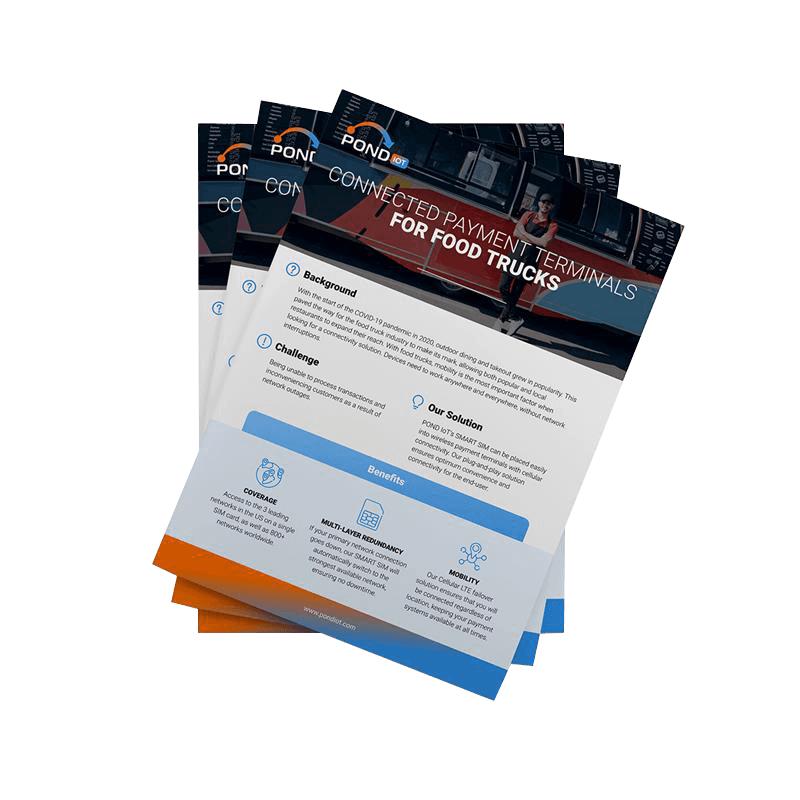


Improving Payment Terminal Connectivity for Food Trucks
Background
Running a food truck means working in a different location almost every day. A truck might spend the lunch rush near office buildings, then move to a neighborhood market or evening event later the same day.
Because of this mobility, internet connectivity is very different from what a traditional restaurant experiences. There is no fixed broadband line or stable network environment. Most trucks rely entirely on wireless payment terminals that connect through cellular networks.
In some locations transactions are completed in seconds. In others the connection can become unstable. Vendors often notice this when moving between districts or when serving customers at crowded events.
For businesses that depend on fast card payments, even a brief connectivity problem can slow the entire line.
Key Challenges
-
Inconsistent network coverage
Food trucks serve customers in many parts of the city. Signal strength can change from one street to another depending on surrounding buildings, network load, and local carrier coverage.
-
Transaction failures
When the cellular connection drops, payment terminals cannot complete the transaction. Vendors may need to retry the payment, which slows service during busy periods.
-
Network congestion during events
Large festivals, concerts, and street markets bring thousands of mobile devices into one area. When the network becomes crowded, payment processing can become noticeably slower.
Use Case Scenario
A food truck operator manages several mobile units that serve customers in different neighborhoods during the week and participate in local events on weekends.
Each truck uses wireless POS payment terminals that rely on cellular connectivity. During peak hours, particularly at outdoor festivals and markets, the operator began noticing recurring connectivity problems. Transactions sometimes took longer than expected, and in some cases they failed completely.
As lines grew longer, these interruptions slowed service and created frustration for both vendors and customers.
Impact of Traditional Connectivity
The payment terminals relied on a single mobile carrier. In many locations the connection worked well, but in others signal strength was weaker or the network became overloaded.
When this happened, payment processing slowed down. Vendors occasionally had to retry transactions several times before a payment went through. During busy service hours, even small delays affected the flow of orders.
For a mobile business that depends on fast transactions, unreliable connectivity quickly becomes a daily operational challenge.
Implementation of the Solution
To improve connectivity, the operator replaced the SIM cards in the payment terminals with POND IoT’s Multi-IMSI SIM.
This SIM allows the terminal to access multiple mobile networks using a single card. Instead of relying on one carrier, the device connects to the network that provides the strongest signal in that location.
The SIM cards were placed directly into the wireless payment terminals already used by the trucks. No hardware replacement or system changes were required. Once installed, the terminals continued processing payments the same way as before.
If the terminal encounters weak coverage on one mobile network, it can connect to another available carrier.
Operational Benefits
-
Broader coverage
Because the SIM can access several mobile networks, the payment terminals maintain connectivity in more locations across the city.
-
Automatic network switching
If one network becomes unavailable or unstable, the terminal connects to another carrier without interrupting the payment process.
-
Reliable mobility
Food trucks can accept payments at markets, festivals, and different city locations without relying on fixed internet connections.
Outcome
After introducing the Multi-IMSI SIM, the operator began seeing fewer connectivity issues across the fleet of food trucks.
Payment transactions became more dependable, even during large outdoor events where mobile networks often experience heavy traffic. Vendors were able to serve customers without repeated payment retries.
With more stable connectivity, service moved faster and the number of failed transactions during busy periods decreased.