

Keeping Farms Connected Across Remote Areas with Multi-IMSI SIM
Background
Connectivity in smart agriculture systems on large farms rarely fails all at once. It drops in parts.
One field holds signal, another does not. Equipment connects in one area, then loses it a few hundred meters away. Some devices report without issues, others stop for a while and then come back.
These gaps are easy to overlook at first, but they affect how the farm is run over time.
More of the daily work now depends on connected systems. Soil sensors, irrigation controls, weather tracking, field equipment. All of them rely on data moving without long interruptions. When that stops, even briefly, decisions get delayed or made with partial information.
The problem is that farms do not sit inside uniform coverage. Terrain changes, distances vary, and signal strength shifts across the property. One network does not perform the same way everywhere.
Multi-IMSI SIM changes how devices deal with that. Instead of staying on a single carrier, they connect to whichever network is usable in that location. In areas where coverage is still limited, satellite can support basic communication for specific systems.
Key Challenges
-
Coverage changes across the property
Signal strength is not consistent. Devices that work fine in one area may struggle in another, especially as they move.
-
Data does not always arrive when needed
Some updates come through on time, others don’t. That makes it harder to rely on the data when timing matters.
-
One network is not enough
With a single-carrier SIM, devices stay connected even when the signal is weak. There is no fallback, so gaps in coverage turn into gaps in visibility.
Use Case Scenario
Kate runs a farm that covers a wide area, with fields spread out across different parts of the property.
Some parts have decent signal. Others don’t. The difference becomes noticeable when devices move between those areas.
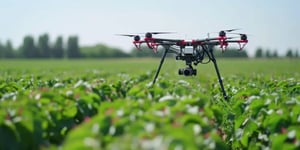
She relies on drones to check crop conditions and uses sensors across the fields to monitor soil and weather. In theory, everything is connected and feeding data into one system. In practice, that connection was not always there.
A drone would complete a survey, but the data would not come through right away. Some sensors would report regularly, while others would go silent for periods of time. It was not a full outage, just enough inconsistency to make the system harder to rely on.
The farm switched to Multi-IMSI SIM to reduce that dependency on a single network.
Devices began connecting to whichever network was available in each location. In areas where cellular coverage was still weak, satellite support helped maintain a basic connection.
The change did not make coverage perfect everywhere, but it reduced the gaps. Data came through more consistently, and the systems became easier to rely on during daily operations.
Impact of Traditional Connectivity
Before this change, connectivity issues showed up in daily operations.
-
Gaps in coverage
Devices would lose connection in certain parts of the farm, especially in more remote areas. This created blind spots in monitoring and tracking.
-
Delayed or missing data
Sensor readings and updates did not always arrive when expected. That made it harder to respond to changes in soil conditions or weather.
-
Reduced operational visibility
With inconsistent connectivity, it was difficult to maintain a clear view of what was happening across all areas of the farm at the same time.
-
Challenges supporting field teams
When communication dropped, coordination between teams working in different locations became less reliable.
-
Limited flexibility as operations grew
As more devices and areas were added, the existing setup struggled to support consistent connectivity without additional workarounds.
Implementation of Multi-IMSI SIM
The change on the farm was not complicated, but it shifted how devices behaved in different areas.
Instead of staying on one network, the SIMs allowed devices to connect to whichever carrier had a usable signal at that moment. As equipment and sensors moved across the property, the connection adjusted with them.
In places where cellular coverage was still weak, satellite support was added for specific use cases. Not everything relied on it, but it helped keep critical data flowing from the areas that were previously disconnected.
The setup did not remove coverage differences across the farm, but it reduced how often devices dropped off completely. That made the system more predictable during daily use.
Operational Benefits
-
Fewer connection drop-offs across the farm
Devices still moved through areas with different signal strength, but they did not lose connection as often. That reduced the number of gaps teams had to work around during the day.
-
Data comes through with fewer interruptions
Sensor updates were not perfectly continuous, but they stopped disappearing for long periods. Information arrived more regularly, which made it easier to trust what was coming in.
-
Field devices behave more predictably
Drones could complete surveys without needing to reconnect before sending data. Equipment stayed online longer, especially when moving between stronger and weaker coverage zones.
-
Communication between teams holds up better
Teams working in separate areas could stay in touch without having to repeat messages or wait for signal to return. This was especially noticeable in parts of the farm that previously had unstable coverage.
-
Less effort spent working around connectivity issues
Before, part of the day was spent dealing with missing data or reconnecting devices. That did not disappear completely, but it became less frequent and less disruptive.
-
Expansion does not introduce the same level of friction
As new areas and devices were added, connectivity did not become an immediate problem to solve each time. The setup handled those additions without the same level of adjustment as before.
Outcome
Across large farms, connectivity is never completely uniform. There will always be areas where signal behaves differently.
What changed here was not the coverage itself, but how the systems handled it.
Devices stopped dropping off as often, and data became more consistent across the property. That made day-to-day decisions easier, because the information behind them was more reliable.
Instead of adjusting operations around weak signal areas, the farm was able to work with fewer interruptions and less uncertainty.