

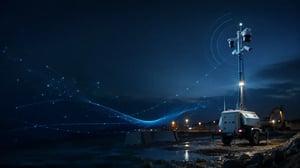
Keeping Security Cameras Connected in Remote and Temporary Locations
Cellular security cameras are useful when surveillance is needed at locations without dependable wired internet or Wi-Fi.
Construction sites, parking lots, remote properties, temporary events, mobile surveillance trailers, and outdoor facilities may all rely on cellular connectivity to transmit video and keep cameras remotely accessible.
For these deployments, the challenge is not simply getting a camera online. It is maintaining a usable connection when coverage, location, and network conditions change.
Background
A modern surveillance system depends on connectivity for more than basic device status.
IP cameras, NVRs, gateways, and cloud video management systems may use the network to transmit live video, upload footage, send alerts, provide remote access, and communicate with monitoring platforms.
At a traditional building, those systems may use fixed broadband.
But many security deployments exist specifically because the location is remote, temporary, mobile, or difficult to reach.
In those environments, LTE or 5G can become the primary connection rather than simply a backup.
Key Connectivity Challenges
No Wired Internet at the Site
Construction sites, vacant properties, parking areas, remote facilities, and temporary security installations may have no practical broadband connection.
Cellular allows surveillance equipment to be deployed without waiting for fixed internet infrastructure.
Carrier Performance Changes by Location
Security systems can be installed almost anywhere.
A carrier with strong coverage at one site may perform poorly at another, especially across rural areas, large properties, dense urban environments, or temporary deployments.
Video Requires More Than Basic IoT Connectivity
A simple sensor may send only small amounts of data.
Video surveillance can require sustained upstream bandwidth for live viewing, cloud recording, footage uploads, and event clips.
That makes network performance and data usage more important than they are in many low-bandwidth IoT applications.
Connectivity Loss Can Mean Visibility Loss
Depending on the system, cameras may continue recording locally during an outage.
But operators can still lose live viewing, remote access, alerts, cloud uploads, or the ability to manage the system until connectivity returns.
Use Case Scenario: Remote Surveillance Across Changing Locations
Consider a security provider operating camera systems at construction sites, parking facilities, vacant properties, and temporary events.
Many of these deployments use mobile surveillance trailers or standalone camera systems because fixed internet is unavailable or impractical.
Cellular is the primary network connection.
At first, the provider standardizes on one mobile carrier.
That simplifies SIM management, but it creates limitations as equipment moves.
The carrier performs well at most locations, yet several construction sites have weak service. A new parking deployment sits in an area where another network is much stronger. A mobile surveillance trailer moves between cities throughout the year.
The hardware is mobile.
The carrier strategy is not.
A multi-carrier SIM changes that by allowing the same surveillance system to access multiple supported cellular networks as it moves between deployment locations.
Use Case Scenario: Remote Surveillance Across Changing Locations
Consider a security provider operating camera systems at construction sites, parking facilities, vacant properties, and temporary events.
Many of these deployments use mobile surveillance trailers or standalone camera systems because fixed internet is unavailable or impractical.
Cellular is the primary network connection.
At first, the provider standardizes on one mobile carrier.
That simplifies SIM management, but it creates limitations as equipment moves.
The carrier performs well at most locations, yet several construction sites have weak service. A new parking deployment sits in an area where another network is much stronger. A mobile surveillance trailer moves between cities throughout the year.
The hardware is mobile.
The carrier strategy is not.
A multi-carrier SIM changes that by allowing the same surveillance system to access multiple supported cellular networks as it moves between deployment locations.
What Happens When Camera Connectivity Fails?
Live Monitoring Can Be Interrupted
Security teams may temporarily lose access to live camera feeds or cloud-based video management systems.
Remote Access Can Disappear
Operators may be unable to reach IP cameras, NVRs, routers, gateways, or other connected security equipment.
Alerts and Video Uploads May Be Delayed
Systems that rely on the network to send event notifications, upload clips, or store footage remotely can be affected when connectivity is unavailable.
Network Problems Can Trigger Site Visits
A remote camera system is often deployed because the location is difficult or expensive to monitor in person.
If operators cannot distinguish a connectivity issue from a hardware issue remotely, a technician may need to visit the site.
Implementing Multi-Carrier Cellular Connectivity
A multi-carrier SIM allows a surveillance system to use more than one supported cellular network.
That is useful when camera locations move or carrier coverage differs from site to site.
The surveillance equipment can connect through:
- A cellular-enabled IP camera
- A cellular router
- A gateway
- An NVR connected through a cellular WAN
- A mobile surveillance trailer with integrated networking
If the preferred network is unavailable or unsuitable at a location, another supported network can be used based on the deployment configuration.
This is particularly useful for mobile or temporary systems.
A trailer deployed at a construction site this month may move to a parking facility, event, or vacant property next month. Multi-carrier connectivity lets the operator adapt to the coverage available at each site without replacing the SIM every time the equipment moves.
Where fixed broadband already exists, cellular can instead provide a secondary network path for failover.
What Makes Security Camera Connectivity Different?
Video surveillance has different network requirements from many other IoT applications.
Data Usage
Continuous video can consume substantial cellular data.
Actual usage depends on factors such as:
- Video resolution
- Frame rate
- Video compression
- Number of cameras
- Recording architecture
- Motion-triggered versus continuous streaming
- Frequency of remote viewing
- Cloud upload requirements
For this reason, the data plan should be designed around the surveillance workload rather than treated like a low-data sensor deployment.
Upload Performance
Security cameras primarily send data out of the site.
That means upstream performance can be especially important for live viewing, cloud recording, and video uploads.
Remote Access
Security teams may need to reach cameras, routers, NVRs, or other equipment remotely.
Depending on the system architecture, remote access may be handled through:
- Cloud VMS platforms
- VPN connections
- Static public IP addresses
- Static private IP addresses
- Private networking
The correct approach depends on the camera platform, security policies, and network design.
What Changes for the Security Operator?
Deploy Cameras Without Waiting for Broadband
Cellular makes it possible to bring surveillance online at locations where wired service is unavailable, temporary, or slow to install.
Move Equipment Between Sites More Easily
A mobile surveillance system can access different supported networks as it moves between locations instead of remaining tied to one carrier.
Reduce Carrier-Specific Exceptions
Operators do not need to predict one mobile network that will perform best at every construction site, parking lot, or remote property.
Preserve Remote Access to Surveillance Systems
Maintaining a usable network connection helps operators keep access to live video, alerts, device status, and remotely managed equipment.
Where This Use Case Fits
Multi-carrier cellular connectivity can support surveillance at:
- Construction sites
- Mobile surveillance trailers
- Parking lots and garages
- Vacant properties
- Remote facilities
- Utilities and infrastructure sites
- Outdoor storage areas
- Temporary events
- Commercial properties
- Retail locations
- Perimeter security deployments
The network design should reflect the cameras, recording method, bandwidth requirements, remote-access needs, and whether cellular is being used as the primary or backup connection.
The Outcome
Remote surveillance exists to give security teams visibility into locations where they cannot always be physically present.
Cellular connectivity makes that possible in places without fixed internet. Multi-carrier connectivity adds another layer of flexibility by allowing the same deployment to access different supported networks when coverage or location changes.
POND IoT supports security and surveillance deployments with multi-carrier LTE/5G connectivity, configurable network selection, cellular failover, static IP options, VPN connectivity, and support for compatible cameras, routers, gateways, and NVRs.
Keep the surveillance system reachable so the people monitoring it can stay connected to what is happening on site.