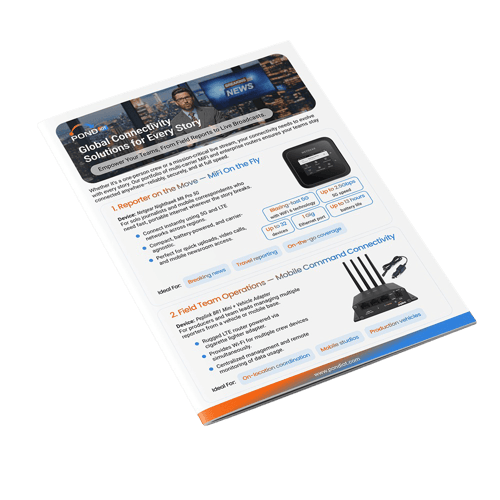


Global Connectivity Solutions for Media Reporting and Live Broadcasts
Background
News rarely happens in places with perfect internet.
A reporter might be standing in the middle of a crowded square where thousands of phones are fighting for the same signal. Another team might be driving between locations while coordinating interviews and uploading video clips. Sometimes the story unfolds far from cities, in places where traditional broadband simply does not exist.
For international media organizations, the situation becomes even more complicated. Journalists often travel between cities, countries, and remote regions while covering major events or developing stories. Reliable connectivity must follow the team wherever the reporting takes place.
Yet the expectation today is simple. Reporters must send updates immediately. Editors expect video files, photos, and live feeds within minutes. Audiences are used to real-time coverage.
This creates a problem for many media organizations. The tools journalists carry have changed dramatically, but connectivity in the field has not always kept up.
To support reporters working outside the newsroom, one international media organization began looking for a more flexible way to keep teams connected. The solution needed to work for different types of reporting, from quick field updates to full live broadcasts, and across multiple regions.
POND IoT provided a connectivity approach that could support all of those scenarios.
Key Challenges
-
Unpredictable connectivity
Journalists rarely choose where a story happens. Sometimes the location has excellent coverage. Sometimes it does not. A single network can easily become unreliable, especially during large public events when thousands of devices connect at the same time.
-
Teams constantly on the move
Reporting teams move a lot. A journalist might start the day filming interviews in one location and finish the evening reporting from somewhere else. In many cases, teams travel between cities or even countries while following major events.
Connectivity has to follow the team instead of depending on fixed infrastructure.
-
Large video files and live streams
Modern reporting relies heavily on video. Uploading footage, sending live updates, and streaming events requires stable bandwidth. When the connection drops, the entire reporting process slows down.
Use Case Scenario
A global media organization covers breaking news, political events, and large public gatherings across several regions. Their reporters rarely stay in one place for long. One team may be reporting from a city center in the morning, while another is already preparing coverage somewhere else.
Some journalists work alone with minimal equipment. Others operate as part of a larger production crew coordinating cameras, interviews, and logistics. During major events, broadcast teams must deliver live video directly to the newsroom.
These teams often operate across different countries and network environments, which makes consistent connectivity difficult to maintain.
For years, the biggest difficulty was not capturing the story. It was sending it.
Reporters often struggled with unstable connections, especially when large crowds gathered in one place. Uploading video files took longer than expected. Live interviews occasionally dropped in the middle of transmission. Even short interruptions could delay coverage.
The organization needed a connectivity setup that could adapt to different reporting environments. It had to support solo reporters, mobile teams, and live broadcast crews at the same time.
Implementation of the Solution
The newsroom needed connectivity that could adapt to different reporting situations. A journalist working alone in the field requires something simple and portable. A production crew coordinating several reporters needs a shared connection. Live broadcasts demand even more stability.
For that reason, the organization did not rely on one type of connection. Instead, different tools were used depending on the role of the team and the situation on the ground.
Connectivity for Mobile Reporters
Device: Netgear Nighthawk M6 Pro 5G
Many reporters work independently and travel light. In those cases a portable hotspot is often enough.
The newsroom uses the Netgear Nighthawk M6 Pro 5G for this purpose. The device is small and battery powered, so journalists can carry it easily and start a connection wherever the story takes them. With it, reporters can upload footage, send photos to editors, or check in with the newsroom without depending on local WiFi.
Mobile Connectivity for Field Production Teams
Device: Peplink BR1 Mini with Vehicle Adapter
When several reporters cover the same story, the team often works from a production vehicle. It becomes the place where equipment is organized and communication with the newsroom continues throughout the assignment.
In these situations the team installs a Peplink BR1 Mini router inside the vehicle. The router runs from a vehicle adapter and creates a shared connection for the crew. Laptops, cameras, and other devices remain online as the team moves between locations. Producers can keep coordinating interviews and sending updates to editors.
Reliable Connectivity for Regional Reporting
Device: Peplink Transit Router
Some assignments take teams across larger areas. Reporters may travel between cities or cover several locations while following the same story.
For this kind of work the newsroom uses the Peplink Transit router. The device supports dual SIM connectivity and can change networks as signal conditions vary. When coverage weakens in one area, the connection shifts to another available network. This helps reporters remain connected while they continue traveling.
High-Bandwidth Connectivity for Live Broadcasts
Technology: SpeedFusion with Starlink Integration
Live broadcasting places the highest demands on connectivity. A brief interruption can affect the entire stream.
To make the connection more reliable, the organization uses SpeedFusion bonding together with Starlink satellite connectivity. Multiple connections operate together as one. If one path becomes unstable, the system continues using the remaining links. Broadcast teams can keep streaming while the event unfolds.
Operational Benefits
After the new connectivity system was deployed, field teams immediately noticed the improvement.
-
Reporters could upload video footage faster and communicate with editors without worrying about unstable connections. Production crews coordinating multiple reporters maintained reliable connectivity while moving between locations.
-
Broadcast teams gained something equally important. Confidence that live coverage would remain stable even during large public events where traditional networks often struggled.
-
The newsroom also gained greater visibility into network performance. Devices could be monitored remotely, allowing technical teams to manage connectivity across different deployments.
Outcome
Reliable connectivity changed the way the organization supported its field teams.
Reporters no longer needed to search for a strong signal before sending footage. Production crews coordinated more smoothly while traveling between locations. Broadcast teams were able to deliver uninterrupted coverage during important events.
Most importantly, journalists could focus on the story itself rather than the technology behind it.
With flexible multi-network connectivity supporting reporting teams across cities, regions, and countries, the organization can now deliver updates from almost anywhere and keep audiences informed in real time.