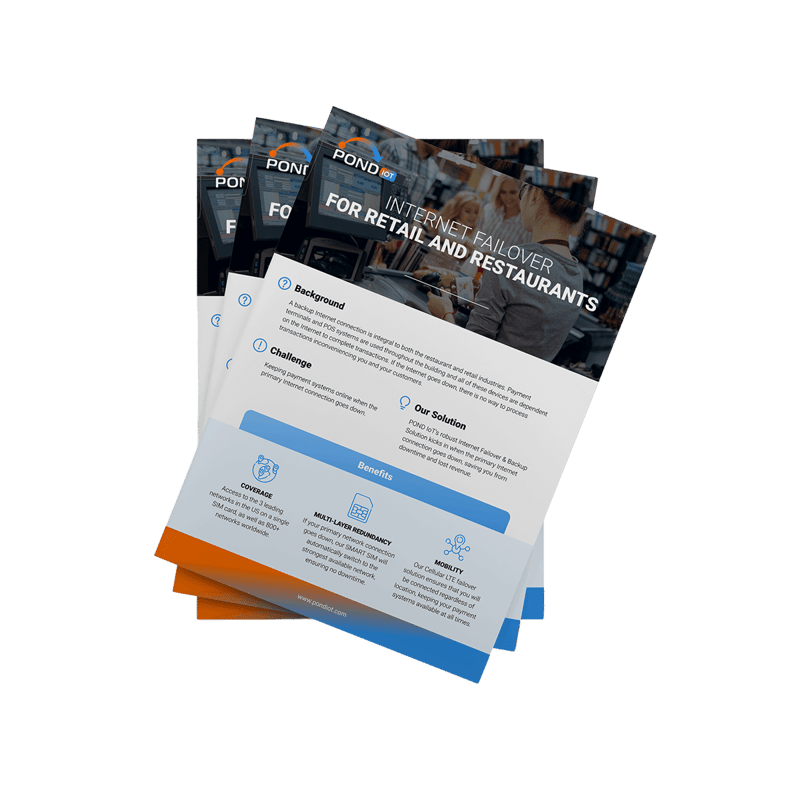


Internet Failover for Retail and Restaurant Payments
Background
Electronic payments are part of everyday operations in retail stores and restaurants. Customers expect to pay quickly, and most transactions now depend on card terminals and POS systems working without delays.
For that to happen, each device needs to stay connected to the payment processing network. When a card is tapped or inserted, the terminal sends a request and waits for approval before the transaction is completed.
In most locations, this connection comes from a fixed internet line inside the building. As long as that connection is stable, everything runs as expected and the process stays almost invisible.
The problem is that the connection is not always stable. Businesses often rely on a single provider, and when that connection drops, even briefly, payment systems stop responding. Transactions cannot go through, and the issue becomes visible immediately.
Internet failover offers a way to avoid that situation by adding a second connection that takes over when the main one is no longer available.
Key Challenges in Retail and Restaurant Connectivity
Businesses that rely on connected payment systems usually start noticing the same pattern when the connection becomes unreliable.
Most locations depend on a single internet line. When that line drops, even for a short time, there is nothing in place to keep the system running. Payment terminals simply lose connection and stop responding.
This becomes most visible at checkout. Transactions cannot be completed, and staff need to pause the process while customers are waiting. Some situations can be managed, but during busy hours even a small delay starts to build.
Without a backup connection, there is very little flexibility in how these situations are handled. The system either works or it does not, and even short interruptions can affect the flow of service.
Use Case Scenario: Payment Interruptions During Busy Hours
A restaurant is in the middle of a dinner rush when the internet connection drops. Orders continue, but when it comes time to pay, the terminals are no longer able to process transactions. Staff try to keep things moving, but the delay becomes noticeable within minutes.
In a retail store, the situation looks similar. Customers reach the checkout, but payments cannot be completed. Some wait, others decide not to continue with the purchase.
It does not take a long outage for this to have an impact. A short disruption is often enough to slow everything down.
Impact of Traditional Connectivity
With a traditional setup, everything depends on the primary internet connection. When it works, it is rarely questioned. When it does not, the limitation becomes clear very quickly.
Payment systems stop until the connection is restored. There is no immediate fallback, and the interruption affects both transactions and the pace of service.
Over time, businesses begin to notice that even small disruptions repeat often enough to create ongoing operational friction, especially in environments where timing matters.
Implementation of Internet Failover
To reduce that dependency, a secondary connection is introduced alongside the primary internet service.
-
A failover router monitors the main connection continuously. If the connection drops or becomes unstable, the system switches to a backup network, typically using cellular LTE.
-
The transition happens automatically, without requiring staff to step in. Payment terminals and POS systems continue to communicate with the processing platform as the connection shifts.
Once the primary connection becomes available again, the system can return to it without interrupting operations.
Operational Benefits
-
After introducing internet failover, payment systems remain available more consistently.
-
Transactions can continue during connection interruptions, which helps avoid delays at checkout and keeps service moving.
-
Staff do not need to manage the switch between networks, which reduces pressure during busy periods.
-
At the same time, operations become more predictable, even in locations where the primary connection is not always stable.
Outcome
With internet failover in place, retail stores and restaurants are less affected by connectivity disruptions.
Payment processing continues more reliably, and interruptions that would previously stop operations become less noticeable.
As businesses continue to depend on digital transactions, having a backup connection becomes part of maintaining steady operations rather than reacting to unexpected outages.