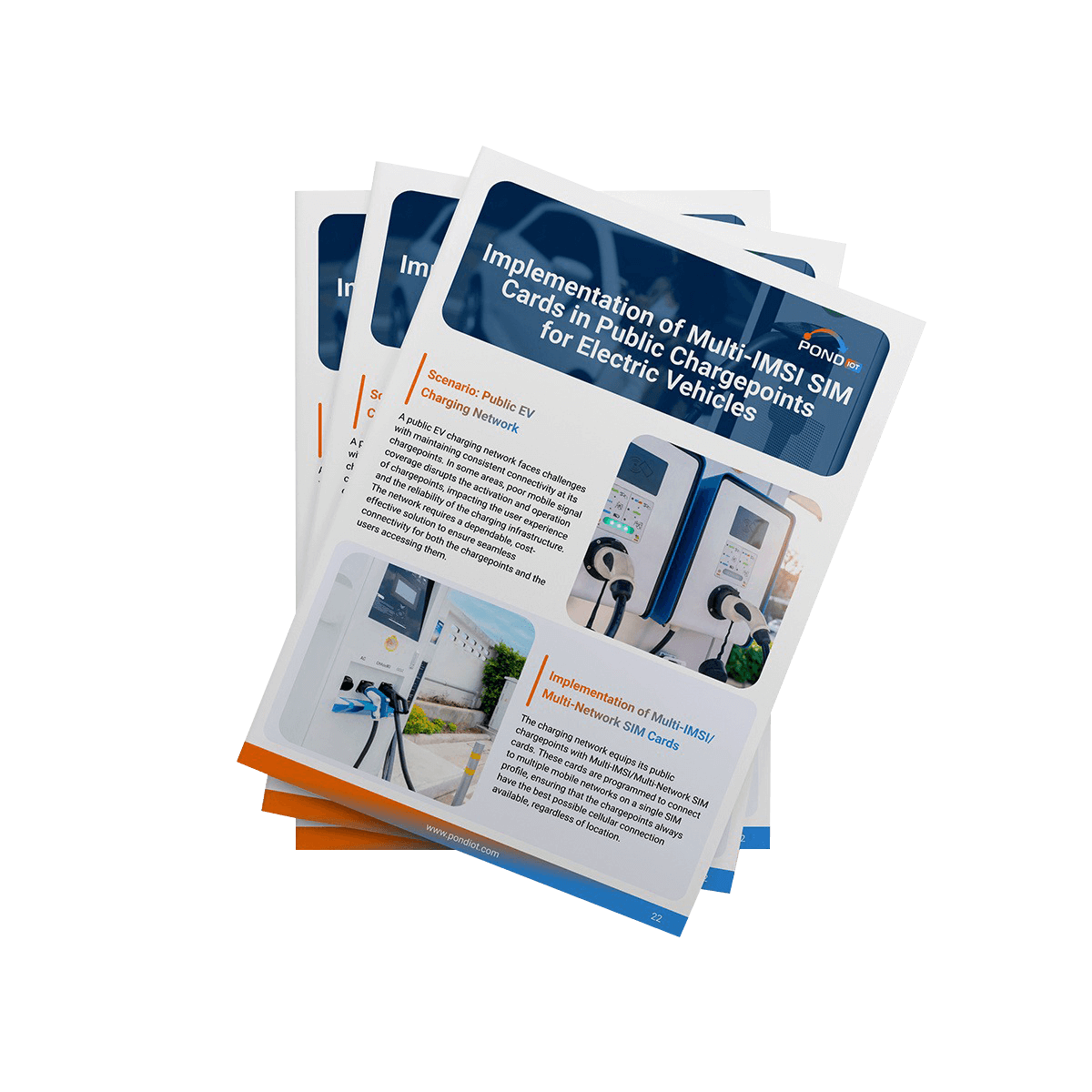


Improving EV Charging Operations
with Multi-IMSI eSIM
Background
Electric vehicles are becoming more common on the road, and charging stations are appearing in many new places. Cities are installing them along streets, businesses are adding chargers to parking areas, and highway routes continue to expand their charging infrastructure.
For operators, installing a charger is only the beginning. Each EV charging station has to stay connected to the central platform that manages the network. Reliable EV charging connectivity solutions help ensure that stations remain online and able to communicate with the management platform. Through that link the platform checks payments, starts charging sessions, and keeps track of the station’s status.
When the link disappears, even briefly, the charger can look unavailable to drivers. The hardware may still be working, but without communication with the backend platform the system cannot start a session.
Mobile coverage plays a big role here. Some locations have strong, stable signals, while others experience weaker reception. Stations placed near dense buildings, underground parking structures, or busy urban areas sometimes struggle to maintain a steady connection.
This is where Multi-IMSI eSIM technology becomes useful. Instead of relying on a single mobile network, the device can access several and connect to the strongest signal available.
Key Challenges in EV Charging Connectivity
Operating a charging network often reveals connectivity challenges as the infrastructure grows.
-
Uneven Cellular Coverage
Signal strength can vary widely between locations. A charger installed in an open parking area may work without issues, while another placed only a short distance away struggles with weaker reception.
-
Starting a Charging Session
Drivers usually activate charging through a mobile app or digital platform. The request must reach the backend system before the charger unlocks and begins delivering power. If the connection is unstable, the process may take longer than expected.
-
Monitoring a Growing Network
As more stations are deployed, operators need visibility across a much larger infrastructure. What started as a few dozen chargers can quickly become hundreds spread across several districts.
-
Operational Workload
When connectivity problems appear, teams must determine whether the issue comes from the charger itself, the software platform, or the mobile network. That investigation can take time.
Use Case Scenario: Managing a Public EV Charging Network
Alex manages a public EV charging network that operates across several districts of a large city. Most of the chargers sit where people already park their cars — near shops, offices, and apartment buildings.
When the network was first deployed, the chargers relied on a traditional cellular setup connected to a single mobile operator. In many areas the connection worked well. In a few locations, however, the signal proved less reliable.
Drivers occasionally reported that a charging session would not start when they tried to activate a charger through the mobile app. Sometimes the charger responded after another attempt. At times the app showed the charger as offline even though the equipment was still running.
When Alex’s team looked through the logs and network reports, one detail stood out. The chargers themselves were rarely the problem. More often the signal was the weak point.
Impact of Traditional Connectivity
As the charging network expanded, these limitations became easier to see.
-
Dependence on a Single Network
Because every charger relied on one mobile operator, connectivity quality varied depending on the location.
-
Additional Troubleshooting
Whenever a station lost connection, engineers needed to check whether the issue came from the hardware, the platform, or the mobile network itself.
-
Limited Flexibility
Changing connectivity settings was not always simple and sometimes meant extra configuration work.
-
Driver Uncertainty
For drivers the situation looked simple: the charger sometimes refused to start. Even a short delay made people wonder whether the station was working at all.
Implementation of Multi-IMSI eSIM
To address these issues, the charging network introduced Multi-IMSI eSIM connectivity across its stations.
Each chargepoint now operates with an embedded connectivity profile that can access several mobile networks. Instead of being tied to a single carrier, the device automatically connects to the network providing the strongest signal at that location.
With a Multi-Network eSIM in place, the charger stays connected to the management platform much more consistently. If one signal weakens, the device simply moves to another network.
There is another benefit as well: remote management. Because the connectivity profile is embedded, operators can adjust network settings without replacing physical components inside the charger.
Operational Benefits
Once the new connectivity setup was in place, the difference became noticeable.
Stations stayed connected to the platform far more consistently, so communication interruptions became rare. Drivers were able to activate chargers through the mobile app with fewer failed attempts.
The operations team could finally see what was happening across the network in real time. Remote control over the connectivity settings made maintenance easier and shortened troubleshooting time.
Running one Multi-IMSI eSIM per station also simplified connectivity management as the network continued to grow.
Outcome
Today the charging network runs far more reliably than before.
Stations now stay online much more consistently, and drivers seldom run into activation problems. Alex’s team spends less time chasing connectivity issues and more time expanding the network.
As more electric vehicles appear on the road, the network can grow without running into the same connectivity problems it faced early on.