



Building a
Carrier-Agnostic
IoT Platform
How POND Delivers Carrier-Agnostic Connectivity Across North America
Enterprise IoT deployments have evolved well beyond simply activating a SIM card and connecting a device to a cellular network. Today's organizations operate thousands—or even hundreds of thousands—of connected assets across diverse geographic regions, each with unique coverage characteristics, operational requirements, and security considerations.
As deployments scale, organizations often discover that the traditional "pick a carrier and deploy everywhere" model no longer meets business requirements. Coverage varies by location, business continuity becomes increasingly important, and operational complexity grows as additional carriers, countries, and applications are introduced.

POND was designed to address these challenges by providing a carrier-agnostic connectivity platform that simplifies how enterprises deploy, manage, and scale cellular infrastructure across North America.
This guide explains the architecture, operational model, and core capabilities that enable resilient enterprise connectivity.
What Does Carrier-Agnostic Mean?
Carrier-agnostic connectivity means your business is not architected around a single mobile network operator.
Instead of designing deployments based on one carrier's coverage map, the platform is designed to support connectivity across multiple participating carrier networks, allowing organizations to build solutions around business continuity, operational efficiency, and geographic flexibility.
The objective is not to replace carriers—it is to reduce dependency on any single carrier strategy.
The Challenges of Traditional Cellular Deployments
Many enterprise deployments begin with a single national carrier.
Initially, this approach offers simplicity.
As deployments grow, several challenges often emerge:
- Coverage varies significantly by location.
- Network performance changes over time.
- Business expansion introduces new geographic requirements.
- Regional outages can affect large portions of a deployment.
- Managing multiple carrier contracts and inventories increases operational complexity.
The larger the deployment, the more these issues become architectural rather than operational.
Carrier Connectivity Across North America
POND's platform is designed to support enterprise connectivity across the United States and Canada through relationships that provide access to major participating mobile networks, subject to coverage, commercial agreements, and deployment requirements.
For organizations operating throughout North America, this enables a more consistent deployment model without requiring different connectivity strategies for each region.

Typical enterprise deployments include:
- Retail stores
- Financial services
- Smart vending
- EV charging
- Industrial IoT
- Transportation
- Public safety
- Managed service providers
Rather than building separate operational processes for each carrier, organizations manage connectivity through a centralized platform.
Multi-IMSI Architecture
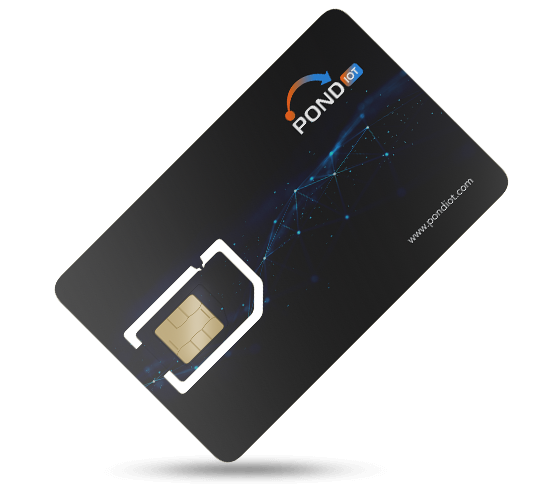
At the core of the platform is Multi-IMSI technology.
Traditional SIM cards are typically associated with a single carrier identity.
A Multi-IMSI SIM can securely maintain multiple carrier identities, enabling greater flexibility depending on the deployment and available network options.
Conceptually, the architecture is straightforward:





Many enterprise applications require predictable addressing for secure communications and remote management.
POND supports deployment models that can include:
- Public static IP addressing
- Private static IP addressing
- Dynamic addressing where appropriate
The appropriate addressing model depends on the application's security requirements, management architecture, and network design.
Static addressing is commonly used for:
- Remote router management
- VPN termination
- Security systems
- Industrial control
- SCADA
- Enterprise edge devices
Many enterprise organizations require network segmentation beyond what is available through public mobile networks.
Private APNs provide a dedicated path between cellular devices and enterprise infrastructure, helping organizations:
- Isolate device traffic
- Simplify routing
- Improve security posture
- Reduce unnecessary exposure to the public internet
- Maintain consistent network policies
Private APNs are frequently deployed alongside VPN technologies to create layered security architectures.
Secure transport remains a critical component of enterprise connectivity.
The platform supports integration with existing VPN architectures, allowing organizations to maintain established security policies while modernizing their cellular infrastructure.
Common enterprise VPN deployments include:
- IPsec
- OpenVPN
- WireGuard (where supported by customer equipment)
- Vendor-specific secure tunnels
Rather than requiring organizations to redesign their security model, POND integrates with existing enterprise networking practices.
Network Redundancy
Enterprise connectivity should be designed around resilience rather than assuming uninterrupted service from any single network.
POND's architecture supports multiple layers of redundancy, including:
- Multi-carrier connectivity
- Multi-IMSI capabilities
- Router-level failover features (where supported)
- Geographic diversity
- Redundant core infrastructure
- High-availability network design
Together, these layers help organizations reduce single points of failure.
Automatic Failover
Business-critical applications often require uninterrupted connectivity.
Depending on the deployment architecture, failover mechanisms can include:
- Carrier selection logic
- Router-based WAN failover
- Dual-WAN architectures
- Multi-modem deployments
- Policy-based routing
The appropriate failover strategy depends on application requirements, hardware capabilities, and desired recovery objectives.
Device Onboarding
Standardized onboarding reduces deployment time and improves operational consistency.
A typical deployment process includes:
SIM Lifecycle Management
Enterprise connectivity extends far beyond initial activation.
Throughout the lifecycle of a deployment, organizations need visibility and control over their SIM inventory.
The platform enables administrators to manage functions such as:
- Activation
- Suspension
- Reactivation
- Usage monitoring
- Inventory tracking
- Status visibility
- Operational reporting
Centralized lifecycle management helps reduce administrative overhead while improving governance.
Monitoring and Operational Visibility
Visibility is essential for operating distributed IoT environments.
POND provides centralized management capabilities that allow organizations to monitor connectivity across their deployments.
Depending on the deployment, organizations can access information such as:
- Connection status
- Data usage
- Network registration
- Carrier information
- Session history
- Device status
- SIM status
- Operational alerts
This visibility enables IT teams to identify issues more quickly and make informed operational decisions.
Security by Design
Security should be integrated into the connectivity architecture from the beginning.
POND's platform supports enterprise security through layered design principles that can include:
- Private APNs
- Secure VPN connectivity
- Static IP options
- Role-based administrative access
- Network segmentation
- Secure authentication
- Centralized management
These capabilities allow organizations to build connectivity solutions that align with broader enterprise security strategies rather than operating as isolated cellular deployments.
Technical Questions?
Our engineering team can help you design the right connectivity architecture for your deployment.Is a Carrier-Agnostic Platform Right for Your Organization?
Organizations are increasingly evaluating connectivity based on long-term operational resilience rather than monthly service cost alone.
A carrier-agnostic architecture may be appropriate for organizations that:
- Operate across multiple geographic regions.
- Support business-critical applications.
- Require secure remote connectivity.
- Need centralized management.
- Plan to scale connected device deployments.
- Want greater flexibility as network conditions evolve.
By reducing dependence on a single carrier strategy, organizations can create a more adaptable connectivity foundation that supports both current operations and future growth.
Frequently Asked Questions
Conclusion
Modern enterprise connectivity is no longer defined by choosing the "best" carrier. It is defined by designing an architecture that can adapt as business requirements, network conditions, and geographic footprints evolve.
POND's carrier-agnostic platform brings together Multi-IMSI technology, secure networking, centralized management, and enterprise-grade operational controls to help organizations simplify deployments across North America.
Whether supporting a few hundred devices or scaling to tens of thousands, the goal remains the same: provide secure, resilient, and manageable connectivity that allows enterprises to focus on their business—not on the complexities of managing multiple cellular networks.

Multi-IMSI Connectivity for Cellular IoT
The landscape of Internet of Things (IoT) connectivity continues to evolve at a remarkable pace. The transformation from traditional methods of connectivity to more advanced, versatile solutions has been not just a technological leap, but a necessity driven by the demands of a rapidly changing world.
-1.png?width=300&name=Multi-IMSI_1200x1200%20(1)-1.png)