

Multi-IMSI SIMs are used in mobile and IoT deployments where relying on a single network is not enough. By allowing devices to connect through more than one mobile operator, they reduce the impact of outages, coverage gaps, and changing network conditions. This article explains how Multi-IMSI SIMs work, why they are used, and where they make the biggest difference in real-world deployments.
When a mobile network goes down, the effects are not limited to phone calls or messages. Systems that depend on cellular access can pause, data transfers may fail, and routine digital tasks can no longer run as expected.
In February 2024, a major outage on the AT&T network left tens of thousands of users without service for several hours. Devices showed SOS mode, businesses were unable to reach key systems, and normal digital workflows were interrupted. Once the network went offline, many connected services stopped responding.
In January 2026, Verizon experienced a large-scale network outage of its own. Across several regions, mobile connections dropped, data traffic slowed or failed, and many systems were unable to communicate again until service returned. Devices tied to a single carrier were once again left waiting, even though other networks were still available in the same locations.
Outages like these lead to a practical question. If network disruptions are part of operating at scale, how should connectivity be set up so that devices and services can continue working when a primary network is no longer available?
Table of Content
- The Reality of Digital Dependence
- How Multi-IMSI SIMs Behave During Network Outages
- Why Multi-IMSI SIM Cards Are a Practical Choice
- POND’s SMART SIM
- FAQ About Multi-IMSI SIMs and Network Outages
The Reality of Digital Dependence
Many systems are built with the assumption that mobile connectivity will always be available. Devices send data continuously, services depend on live updates, and workflows are designed around uninterrupted access to networks. This is common in setups such as vehicle tracking systems, remote monitoring devices, or connected payment terminals that rely on constant communication.
Once the connection drops, systems that rely on regular updates start to fall behind. Some data stops arriving, updates are skipped, and actions that depend on fresh information no longer run on schedule.
Instead of receiving updates as expected, some systems stop reporting changes, monitoring data may arrive late, and certain actions cannot be completed until the connection comes back.
When a single network is unavailable, devices that depend only on that network simply wait. They are powered on, but no data moves until service is restored.
How Multi-IMSI SIMs Behave During Network Outages
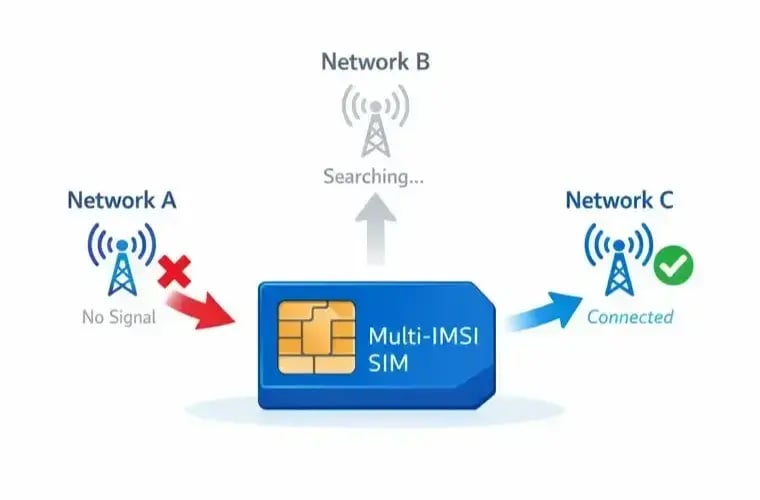
A Multi-IMSI SIM differs from a single-network SIM in how it handles loss of service. Instead of being tied to one mobile network, the SIM has access to more than one network identity that can be used during connection attempts.
When a network becomes unavailable, the device does not simply wait for that network to recover. The SIM can attempt to reconnect using another available network identity, rather than staying idle until the original network is restored. This allows communication to continue without manual intervention or physical access to the device.
During an outage, connected systems spend less time waiting for a network to come back. Data can start moving again once another network is available.
At POND IoT, we provide advanced IoT SIM cards built for global coverage, secure data transfer, and easy device management.
Why Multi-IMSI SIM Cards Are a Practical Choice
Network disruptions are not unusual, especially in mobile environments. Coverage can disappear without warning, and outages can affect large areas at once. In setups that depend on a single mobile network, this often means devices stop communicating until service is restored.
Multi-IMSI SIM cards are used to reduce that dependency. By giving devices access to more than one mobile network identity, they make it possible to reconnect through another network when the first one is no longer available. The goal is not to eliminate outages, but to limit how much those outages affect daily operations.
This becomes especially relevant in deployments that run continuously and without direct supervision. Devices such as vending machines, kiosks, ATMs, or EV charging stations are expected to remain reachable at all times, even when network conditions change due to maintenance, congestion, or unexpected failures. With Multi-IMSI, connectivity does not rely on one predefined path.
Teams do not have to chase problems caused by a single carrier or rebuild connectivity setups for each new location. Devices follow the same logic wherever they operate, even though the underlying networks may differ.
In that sense, Multi-IMSI SIMs are less about adding new capabilities and more about removing weak points. They help systems continue operating through change rather than stopping whenever one network becomes unavailable.
POND’s SMART SIM
SMART SIM is POND IoT’s Multi-IMSI SIM. It is used in deployments where devices need to stay connected across different mobile networks and locations.
The SIM does not rely on one carrier. If a network stops responding, another available network can be used instead. This happens at the SIM level and does not require changes on the device or manual action on site.
SMART SIM is not limited to handling outages. It is used as a regular connectivity option for devices that move, operate remotely, or run without direct supervision. The same SIM can stay in place while network conditions change around it.